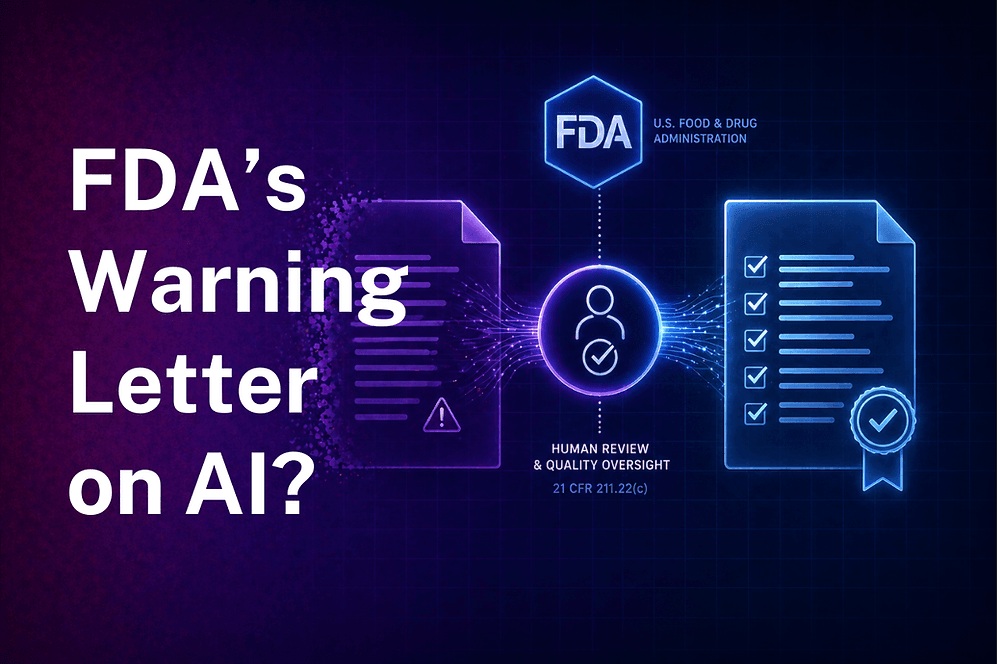
The FDA just mentioned AI in a warning letter. Before you panic, read what it actually said.
A lot of people in regulated industries are skeptical of AI. Honestly, they are not wrong. There is already too much noise. Too many tools overpromising and underdelivering.
So when FDA mentions AI in a warning letter, people pay attention.
They should. But for the right reason.
FDA did not reject AI. FDA rejected blind reliance.
In its April 2026 warning letter to Purolea Cosmetics Lab, FDA did not describe a competent operation that stumbled because of a new tool.
It described:
- a facility with insects, filth, leaves, and clutter in manufacturing areas
- a docking bay door that exposed manufacturing to the outside environment when opened
- finished drug batches released without required microbiological testing
- a quality unit that failed to ensure batch records were reviewed before release
Then FDA got to the AI part.
The firm used AI agents to generate drug product specifications, procedures, and master production or control records.
When investigators found that required process validation had not been conducted before distribution, the firm’s response was that it did not know the requirement existed because the AI agent never told them.
That is the moment.
Not because AI failed. Because no human was doing their job.
FDA’s position was precise: if AI is used in CGMP activities, the output must be reviewed and cleared by an authorized human representative of the quality unit. FDA said the failure to do that violated 21 CFR 211.22(c).
The problem was not that AI was used. The problem was that AI output was treated as judgment.
That is not an AI failure. That is an oversight failure, inside a facility that was already failing multiple basic CGMP expectations.
Weak systems misuse tools. Strong systems make tools powerful.
AI did not create Purolea's failures.
Insects in the facility, no batch review, no microbiological testing — those existed long before any AI agent was involved.
AI just made the gap between the documents and the reality harder to hide.
Weak companies misuse tools. Strong companies build systems that make tools useful.
The real lesson: do not outsource accountability.
FDA's standard is not complicated.
Use AI. Review the output. Keep humans responsible for every decision that matters.
That is not anti-AI.
That is the correct standard for any tool used in regulated work.
The companies that already operate that way have nothing to fear from this warning letter.
They are already ahead.
AI is the future. That is exactly why the standard matters.
AI is not valuable because it makes documents look polished.
It is valuable because it compresses work that used to take days into hours.
It can search large volumes of guidance fast, compare documents and catch gaps, build structured first drafts, cut repetitive expert time, and free up your best people to focus on the decisions only they can make.
That is a compounding operating advantage.
The future will not belong to teams that avoid AI. It will belong to teams that govern it properly and then use it aggressively.
Three paths. One winner.
No AI. Feels safer. Is not. Slower submissions, higher expert costs, widening gap against competitors who figured this out.
Reckless AI. Fast documents, no review, no controls. This is exactly what FDA is warning against. The risk is now documented in a public warning letter.
Governed AI. Use it hard, review everything, keep humans accountable for decisions. This is the highest-performance model — not the cautious middle ground. It compounds faster than manual work and carries none of the compliance risk of ungoverned AI.
The standard has been set.
This warning letter does not prove AI should stay out of regulated work.
It proves the opposite: AI without oversight is a liability. AI with strong oversight is a serious competitive advantage.
FDA did not hand the industry a warning. It handed the industry a framework.
Use AI. Review it. Govern it. Own the decisions.
The companies that do that well will not just stay compliant. They will move faster than teams still afraid to start, and they will outrun teams that started without the right controls.
The Fastest Path to Market