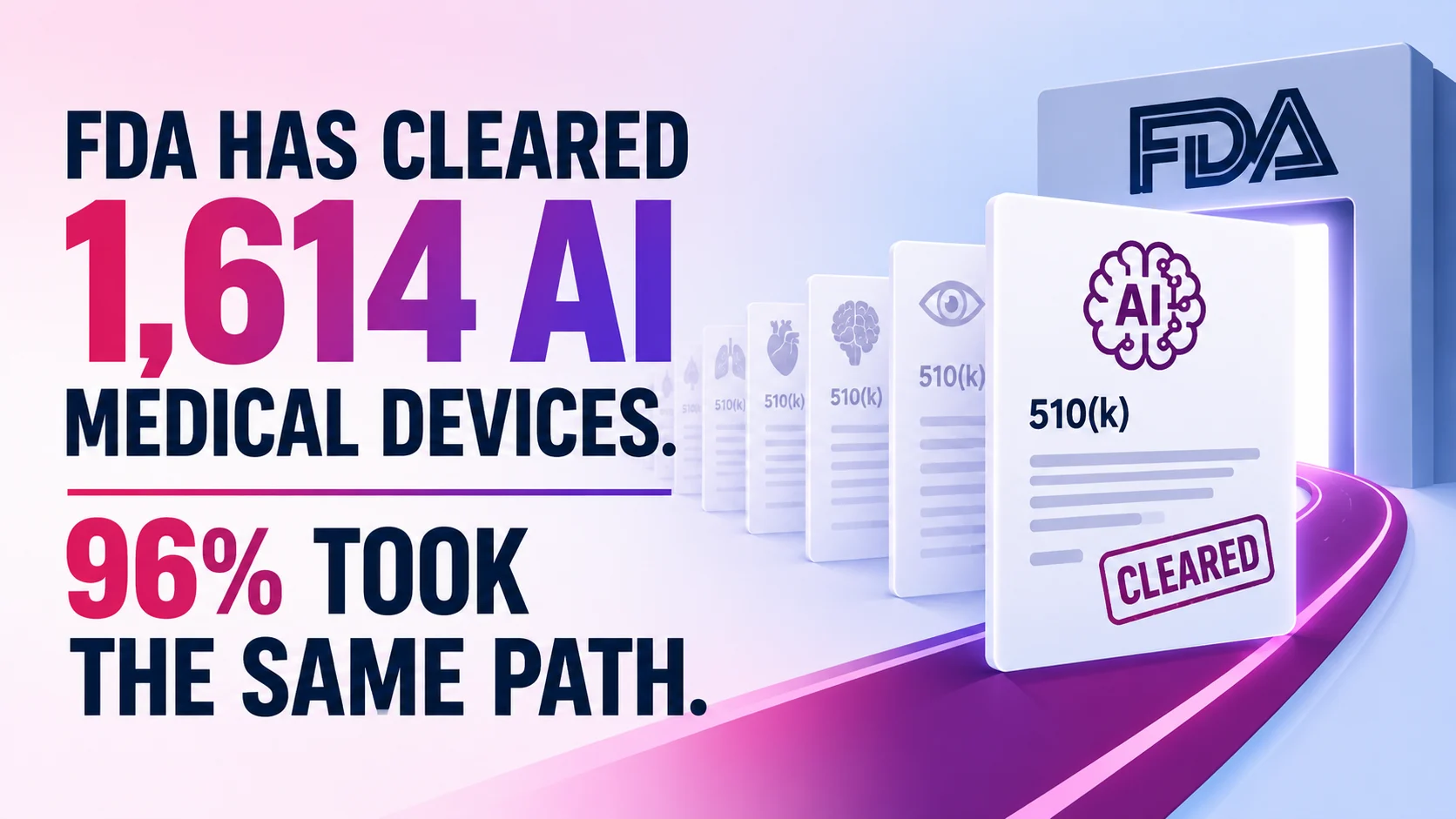
Quick Answer: As of 29 June 2026, FDA's own AI-Enabled Medical Device List names 1,614 authorized devices [1, 2]. Almost all of them took the same route: 96.2% cleared through 510(k), versus 2.5% De Novo and 1.3% PMA [2]. If you are planning an AI-enabled device for the US market, the standard predicate-based pathway is the one to plan around, not a novel one.
Two other findings shape how you should plan. Radiology alone accounts for 76.2% of every device on the list [2], so a device outside radiology faces a thinner predicate landscape but far less competition. And growth is accelerating: 335 devices cleared in 2025, with 181 already cleared in the first six months of 2026 [2].
Companies from Korea, China, Israel, and Japan are already on that list in real volume, not as rare exceptions. Samsung Medison, a Korean company, has 13 devices cleared.
The concentration is starker than the general narrative suggests
Everyone in this space knows radiology leads AI device clearances. Few people have actually run the number. Analyzing FDA's complete list directly puts it at 76.2% [2], more than three out of every four AI-enabled devices FDA has ever authorized.
| Panel (specialty) | Devices | Share |
|---|---|---|
| Radiology | 1,230 | 76.2% |
| Cardiovascular | 154 | 9.5% |
| Neurology | 73 | 4.5% |
| Anesthesiology | 30 | 1.9% |
| Gastroenterology-Urology | 27 | 1.7% |
| Hematology | 22 | 1.4% |
| All other specialties combined | 78 | 4.8% |
Best for: understanding where AI device clearance is a crowded, precedent-rich category versus genuine white space. Radiology's dominance means predicate availability is rarely the constraint there; the constraint is differentiation against hundreds of existing cleared devices. Specialties in the "all other" row, dental, obstetrics and gynecology, microbiology, general hospital, ophthalmic, tell close to the opposite story: fewer predicates to build on, but far less competitive density.
What this means for your specialty
Nine specialties combined account for barely a fifth of the entire list. If your device sits in one of them, that scarcity cuts both ways: a thinner predicate landscape to search, and a market where you'd be one of a genuinely small number of cleared products, not competing against a category that's already seen a decade of iteration.
Nearly everything clears through 510(k), not a novel pathway
Almost every AI device on the list took the same route. Of the 1,614 devices, 1,553 (96.2%) cleared through 510(k). Only 40 (2.5%) went through De Novo, and 21 (1.3%) through PMA [2].
That distribution is a direct, data-backed confirmation of something worth internalizing if you're planning an AI device strategy: the overwhelming majority of AI-enabled devices reaching the US market are demonstrating substantial equivalence to something already cleared, not establishing a new category. The De Novo and PMA counts aren't nothing, forty-one devices have had to prove genuinely novel risk profiles from scratch, but they're the exception. For most AI device developers, the practical question is finding the right predicate, not preparing for a novel-pathway submission.
Growth is accelerating, and 2026 is on pace to be the biggest year yet
The year-by-year pattern is a clean acceleration curve, not a steady climb.
| Period | Devices cleared |
|---|---|
| 1995-2015 (first 20 years) | 41 |
| 2016 | 18 |
| 2019 | 80 |
| 2022 | 162 |
| 2024 | 235 |
| 2025 | 335 |
| 2026 (through 29 June only) | 181 |
The first two decades of AI-enabled device clearances, from the first entry in 1995 through the end of 2015, produced 41 devices combined [2]. 2025 alone produced more than eight times that in a single year. And 2026's total through just the first six months already exceeds every full year prior to 2023.
What this means for timing your own submission
None of this changes FDA's own review mechanics. The volume increase reflects more submissions, not a faster or looser review standard, and FDA's MDUFA V goals and real average review times apply the same way to an AI-enabled device as to any other 510(k). What it does mean is that the competitive and precedent landscape you're evaluating today looks meaningfully different from what it looked like even two years ago, and will likely look different again by the time your own submission is ready.
Companies from at least six countries are already succeeding here
This is not a US-only category. The top submitters by device count:
- Siemens — 56 devices, across its US and German entities
- Canon Medical Systems — 42 devices (Japan)
- Aidoc — 30 devices (Israel)
- Shanghai United Imaging Healthcare — 29 devices (China)
- Samsung Medison — 13 devices (Korea)
- Plus Philips, GE, Clarius, Hyperfine, and Viz.ai
Manufacturers based in China, Korea, Israel, Japan, Germany, and the Netherlands sit among the most prolific submitters in the entire dataset. If you are weighing whether an international manufacturer can genuinely compete for FDA clearance of an AI-enabled device, the answer from the data is that several already do, at scale.
PCCP adoption, by the one signal we can actually measure, remains early
Visible PCCP adoption is far lower than its guidance profile suggests. We covered FDA's PCCP framework for AI-enabled devices in detail separately, including the final guidance issued in December 2024. One narrow but concrete data point from this dataset: only 2 of the 1,614 listed devices explicitly note "(with PCCP)" in their public device name [2]; Tyto Insights for Wheeze Detection, cleared June 2026, and Fibresolve, cleared November 2025.
Why this number is a floor, not a full count
This almost certainly understates real PCCP usage, since a device can have an authorized PCCP without that being reflected in its public name, and FDA's list captures the name as submitted, not a structured PCCP field. Treat it as a weak signal, not a comprehensive count. But as far as visible evidence goes, two years after the framework's headline final guidance, explicit public PCCP branding is still rare rather than standard practice.
A caveat FDA states about its own list, and one we'd add
FDA states the limits of its own list plainly. It is not comprehensive: it identifies devices primarily by AI-related terms appearing in marketing authorization summaries or device classification, based on FDA's own Digital Health and Artificial Intelligence Glossary [1, 3], and devices authorized but not yet reflected in a published decision summary are added in later updates. Some AI-enabled devices, particularly ones where AI plays a supporting rather than headline role, may not be captured at all.
Our own addition: percentages and totals in this analysis reflect the dataset as downloaded on 29 June 2026 (FDA's most recent entry at the time of this analysis). FDA updates the list periodically, so exact figures will shift; the structural findings, radiology's outsized share, 510(k)'s dominance as a pathway, and the accelerating growth curve, are unlikely to shift materially with normal periodic updates.
Common mistakes
Assuming "AI in medical devices" is evenly distributed across specialties. It isn't. Three specialties account for roughly 90% of every device on FDA's list.
Treating De Novo as a common pathway for AI devices because it gets disproportionate press coverage. It accounts for 2.5% of actual clearances. Novel AI device categories attract attention precisely because they're rare.
Assuming international manufacturers are a marginal presence in AI device clearance. Several are among the highest-volume submitters in FDA's entire dataset.
Reading PCCP's guidance attention as a proxy for adoption. Visible, named PCCP usage remains rare relative to the volume of AI devices being cleared overall.
Frequently asked questions
How many AI-enabled medical devices has FDA cleared? As of 29 June 2026, FDA's own AI-Enabled Medical Device List names 1,614 authorized devices, dating back to the first entry in 1995. The list is not comprehensive by FDA's own description, so the true number of AI-enabled devices in the US market may be somewhat higher.
What percentage of AI medical devices are radiology devices? 76.2% of the 1,614 devices on FDA's list are classified under the Radiology panel, based on direct analysis of the complete dataset. Cardiovascular is a distant second at 9.5%, followed by Neurology at 4.5%.
Do most AI-enabled devices go through 510(k) or a novel FDA pathway? The overwhelming majority, 96.2% in FDA's own data, clear through the 510(k) pathway by demonstrating substantial equivalence to an existing predicate. De Novo accounts for 2.5% and PMA for 1.3%, meaning genuinely novel-pathway AI devices are the exception, not the norm.
Is AI-enabled device clearance growing or slowing down? Growing sharply. FDA's data shows 335 devices cleared in 2025, and 181 already cleared in just the first six months of 2026, a pace on track to exceed 2025's full-year total.
Do international manufacturers actually succeed in getting AI devices cleared by FDA? Yes, at meaningful scale. Manufacturers based in China, Korea, Israel, Japan, Germany, and the Netherlands are among the highest-volume submitters in FDA's complete dataset, alongside US-based companies.
How many FDA-cleared AI devices actually use a Predetermined Change Control Plan? Based on public device naming alone, very few: only 2 of 1,614 devices explicitly note PCCP in their device name. This likely undercounts actual usage, since PCCP status isn't a structured, searchable field in FDA's list, but it's the only concrete signal publicly visible in the dataset.
Where is FDA's AI-Enabled Medical Device List published? On FDA's own Digital Health Center of Excellence site, updated periodically, with downloadable CSV, Excel, and XML versions. FDA states the list identifies devices primarily through AI-related terminology in marketing authorization summaries and device classification, based on its own Digital Health and Artificial Intelligence Glossary, and explicitly describes the list as non-comprehensive.
Which company has the most FDA-cleared AI-enabled devices? Siemens leads with 56 devices across its US and German entities, based on direct analysis of FDA's complete dataset, followed by Canon Medical Systems at 42 and Aidoc at 30. The leaderboard mixes legacy imaging equipment manufacturers with AI-native companies founded specifically to build diagnostic software, and includes manufacturers headquartered across at least six countries.
Key takeaways
Radiology's dominance is more extreme than general awareness suggests. 76.2% concentration means most specialties remain comparatively open ground, with real predicate scarcity as the tradeoff.
510(k) is how AI devices actually reach market. 96.2% of clearances use it. De Novo's outsized media attention doesn't reflect its 2.5% share of actual volume.
The pace of clearances is accelerating, not plateauing. 2026 is on track to be the highest-volume year FDA's list has ever recorded.
International manufacturers are already competing successfully, not just entering. Several sit among the highest-volume submitters in FDA's entire dataset.
PCCP's guidance visibility and its actual adoption footprint are two different things. Public naming data suggests real-world uptake remains early, whatever the volume of guidance and commentary around it.
Complizen helps international medical device manufacturers reach FDA 510(k) clearance, combining a software platform for in-house regulatory teams with full-service consultancy for teams without in-house FDA expertise.
Understanding exactly where your device sits in this landscape, crowded predicate territory or genuine white space, is a strategic question worth answering with real data rather than general impressions. Complizen's Superagent platform indexes FDA's own device and clearance databases directly, the same primary source behind this analysis, to map your specific product against the current landscape. See how the platform works →
References
- FDA — Artificial Intelligence-Enabled Medical Devices (AI-Enabled Medical Device List, source page). https://www.fda.gov/medical-devices/software-medical-device-samd/artificial-intelligence-enabled-medical-devices
- FDA — AI-Enabled Medical Device List, complete dataset (CSV, downloaded 29 June 2026 update). https://www.fda.gov/media/178541/download?attachment
- FDA — Digital Health and Artificial Intelligence Glossary, Educational Resource. https://www.fda.gov/science-research/artificial-intelligence-and-medical-products/fda-digital-health-and-artificial-intelligence-glossary-educational-resource