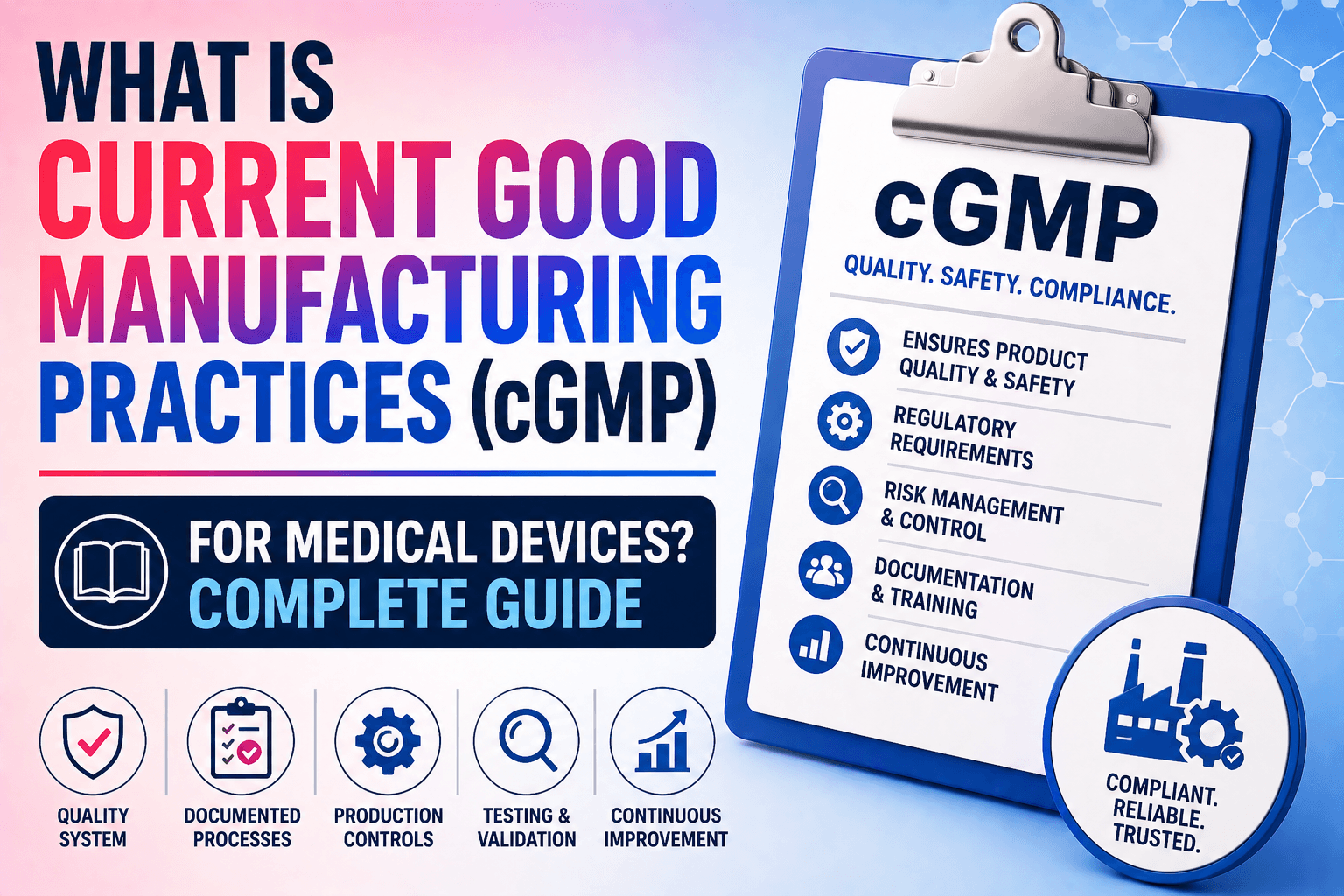
In FDA device world, “cGMP” obligations are implemented via the Quality System Regulation (21 CFR 820). On Feb 2, 2026, FDA’s Quality Management System Regulation (QMSR) replaces QSR and incorporates ISO 13485:2016 by reference. Drug cGMPs remain 21 CFR 210/211; combination products follow 21 CFR Part 4.
This guide covers CGMP requirements, FDA enforcement realities, and implementation strategies that support regulatory approval success.
What Does CGMP Stand For and Why It Matters
Current Good Manufacturing Practice Defined
CGMP represents the minimum manufacturing standards that FDA requires for medical device production. The "current" aspect means these standards evolve with technology and industry best practices.
Unlike static regulations, CGMP requirements adapt to reflect current industry capabilities and scientific understanding. What constituted good manufacturing practice in 1990 differs significantly from today's standards.
The Business Reality of CGMP Compliance
Manufacturing compliance directly impacts regulatory approval success.
FDA reviewers examine manufacturing evidence in 510(k), PMA, and De Novo submissions to determine whether you can consistently produce the device described in your application.
Poor manufacturing controls hinders regulatory submissions.
Companies with inadequate CGMP compliance face additional information requests, approval delays, or outright rejection regardless of how innovative their technology might be.
Post-market enforcement is aggressive.
FDA conducts thousands of manufacturing inspections annually, with non-compliance resulting in warning letters, consent decrees, or product recalls that can destroy businesses overnight.
CGMP vs. GMP: Understanding the Medical Device Difference
Why Medical Devices Need Enhanced Standards
- General GMP applies broadly across food, drug, and cosmetic manufacturing.
- CGMP for medical devices includes additional requirements that reflect the unique risks and complexity of medical device manufacturing.
- Risk-based manufacturing controls tailored to device classification and intended use.
- Design control integration linking development activities to manufacturing processes.
- More rigorous process validation for processes that cannot be fully verified through testing.
Key CGMP Enhancements for Medical Devices
- Device-Specific Requirements: FDA's Quality System Regulation (21 CFR Part 820) incorporates CGMP principles with medical device-specific additions including design controls, risk management integration, and corrective/preventive action systems.
- Classification-Based Requirements: Class III devices require more stringent manufacturing controls than Class I devices. Higher risk devices demand enhanced process validation, environmental controls, and quality testing.
- Software and Combination Product Considerations: Software medical devices and combination products have additional CGMP requirements addressing software lifecycle processes and component integration controls.
Core CGMP Requirements: What You Must Implement
Personnel and Training Requirements
- Competency-Based Training: All personnel must be trained for their specific job functions. Training must be documented, verified, and updated when processes change or performance issues arise.
- Responsibility and Authority: Clear definition of roles and responsibilities for all manufacturing activities. Management must ensure adequate resources for CGMP compliance.
- Contamination Prevention: Personnel practices that prevent contamination including appropriate clothing, hygiene procedures, and access controls for critical manufacturing areas.
Facility and Equipment Controls
Facility Design:
- Manufacturing facilities must be designed to prevent contamination and mix-ups
- Adequate space, lighting, ventilation, and workflow to support quality manufacturing
- Environmental controls appropriate for device manufacturing requirements
Equipment Qualification:
- All manufacturing equipment must be qualified for its intended use
- Installation qualification (IQ), operational qualification (OQ), and performance qualification (PQ)
- Documented procedures and records for all qualification activities
Maintenance and Calibration:
- Scheduled maintenance and calibration programs to ensure equipment operates within specifications
- Documented procedures and records for all maintenance activities
- Equipment status identification and control
Manufacturing Process Controls
- Process Validation: Manufacturing processes that cannot be fully verified through final product testing must be validated. Process validation demonstrates consistent production of devices meeting specifications.
- In-Process Controls: Monitoring and control of critical process parameters during manufacturing. Real-time adjustments when parameters exceed acceptable limits.
- Environmental Controls: Appropriate environmental conditions for manufacturing including temperature, humidity, and cleanliness controls. Environmental monitoring and corrective actions when conditions exceed limits.
Quality Control and Testing
Incoming Material Controls:
- Inspection and testing of incoming materials to ensure they meet specifications
- Supplier qualification and monitoring to prevent defective materials from entering production
- Material identification and control throughout the manufacturing process
In-Process Testing:
- Testing during manufacturing to verify process performance and product quality
- Statistical process control where appropriate to monitor trends and variability
- Documentation of all testing activities and results
Final Product Testing:
- Comprehensive testing of finished devices to verify they meet all specifications
- Release criteria and documentation before distribution
- Investigation and resolution of testing failures
FDA Enforcement Reality: What Happens When You Get It Wrong
Inspection Frequency and Focus
FDA conducts approximately 2,500 medical device facility inspections annually. High-risk device manufacturers face more frequent inspections, typically every 2-3 years.
Recent inspection trends show increased focus on process validation, software controls, and cybersecurity measures. Remote regulatory assessments have become more common since 2020.
CGMP violations consistently rank among the top FDA 483 observations including inadequate process validation, insufficient design controls, and poor corrective action systems.
Enforcement Consequences
Warning Letters: Formal notification of significant CGMP violations requiring immediate corrective action. Public disclosure damages company reputation and can impact business relationships.
Consent Decrees: Court-enforced agreements requiring comprehensive CGMP remediation under FDA oversight. Operations may be suspended until compliance is demonstrated.
Product Recalls: FDA can require product recalls when CGMP violations create safety risks. Class I recalls for life-threatening situations can destroy company value overnight.
The Cost of Non-Compliance
Direct costs include inspection response activities, consulting fees for remediation, facility and process modifications, and potential legal expenses.
Indirect costs often exceed direct costs including delayed product launches, lost sales during remediation, damaged customer relationships, and reduced company valuation.
Industry data shows companies can spend $1-5 million remediating serious CGMP violations, with some complex cases exceeding $10 million in total costs.
How CGMP Supports Your FDA Submission Strategy
Manufacturing Evidence in Regulatory Submissions
510(k) Submissions: Manufacturing information demonstrates your ability to produce devices substantially equivalent to predicate devices. Process validation data and quality control results support substantial equivalence claims.
PMA Submissions: Comprehensive manufacturing information including facility descriptions, process validation, and quality control procedures. Manufacturing changes require PMA supplements with supporting validation data.
De Novo Submissions: Manufacturing controls and validation data help establish special controls for novel device categories. Risk mitigation through manufacturing controls supports safety and effectiveness arguments.
Design Control Integration
Design Transfer: CGMP requirements for transferring designs from development to manufacturing. Validation that manufacturing processes can consistently produce devices meeting design specifications.
Design Changes: Manufacturing impact assessment for all design changes. Process validation updates when changes affect manufacturing procedures or controls.
Design History File Integration: Manufacturing procedures, validation protocols, and records become part of design history documentation supporting regulatory submissions.
Quality System Synergy
ISO 13485 Alignment: CGMP requirements align with ISO 13485 manufacturing and quality control provisions. Integrated approach reduces duplicative systems and documentation.
Risk Management Integration: Manufacturing risk controls support ISO 14971 risk management activities. Manufacturing controls become risk mitigation measures in overall risk management plans.
Post-Market Surveillance: Manufacturing data supports post-market surveillance and vigilance reporting. Trending and analysis of manufacturing issues inform safety updates and labeling changes.
Common CGMP Implementation Mistakes
Documentation Pitfalls
- Over-Documentation: Creating elaborate procedures that don't reflect actual manufacturing practices. Procedures must be practical and executable by manufacturing personnel.
- Under-Documentation: Insufficient documentation of critical manufacturing steps and controls. FDA expects documented evidence of all CGMP compliance activities.
- Inconsistent Documentation: Conflicting information between procedures, work instructions, and actual practices. Regular review and updates ensure documentation accuracy.
Process Validation Failures
- Inadequate Protocol Design: Process validation protocols that don't address critical quality attributes or process parameters. Protocols must demonstrate process capability under worst-case conditions.
- Insufficient Data Collection: Limited data that doesn't support statistical conclusions about process performance. Adequate sample sizes and measurement systems required for valid conclusions.
- Poor Change Control: Process changes without corresponding validation updates. Revalidation requirements when changes could affect product quality or safety.
Quality Control Deficiencies
- Inadequate Testing: Insufficient testing to verify device performance and safety characteristics. Testing must cover all critical quality attributes identified during design and risk analysis.
- Poor Laboratory Controls: Inadequate laboratory facilities, equipment, or procedures for quality control testing. Laboratory qualification and ongoing monitoring ensure reliable test results.
- Weak Investigation Procedures: Inadequate investigation of quality control failures and non-conformances. Root cause analysis and corrective actions prevent problem recurrence.
CGMP: Your Foundation for Manufacturing Excellence and Regulatory Success
CGMP compliance represents more than regulatory obligation—it's the manufacturing foundation that enables consistent production of safe, effective medical devices while supporting successful FDA submissions.
Success requires systematic implementation starting now. Half-measures in CGMP compliance create regulatory risks that can destroy business value overnight.
Your manufacturing capabilities determine whether your innovative medical devices reach patients safely and efficiently. Make CGMP compliance your competitive advantage.
The Fastest Path to Market
No more guesswork. Move from research to a defendable FDA strategy, faster. Backed by FDA sources. Teams report 12 hours saved weekly.
Frequently Asked Questions
Do software medical devices need CGMP compliance?
Yes. Software medical devices must comply with CGMP requirements including design controls, process validation, and quality control systems adapted for software manufacturing.
Software build processes, version control, and deployment procedures require validation and documentation according to CGMP principles.
How often does FDA inspect CGMP compliance?
High-risk manufacturers (Class III) face inspections every 2-3 years. Lower-risk manufacturers may be inspected every 3-5 years, but FDA also conducts "for cause" inspections based on complaints or adverse events.
Inspection frequency increases for companies with compliance history or products involved in safety issues.
What's the difference between CGMP and ISO 13485?
CGMP is FDA's mandatory manufacturing standard incorporated into 21 CFR Part 820. ISO 13485 is an international quality management standard that includes manufacturing requirements.
ISO 13485 certification helps demonstrate CGMP compliance but doesn't replace FDA regulatory requirements or inspection oversight.
Can you get FDA approval without CGMP compliance?
No. CGMP compliance is mandatory for all medical device manufacturers selling in the United States, regardless of device classification or approval pathway.
Regulatory submissions require manufacturing information demonstrating CGMP compliance, and FDA inspections verify ongoing compliance.
What happens if FDA finds CGMP violations?
Minor violations result in FDA 483 observations requiring corrective action responses. Major violations trigger warning letters, product recalls, or consent decrees that can shut down manufacturing operations.
All enforcement actions are public and can significantly impact business operations and company reputation.