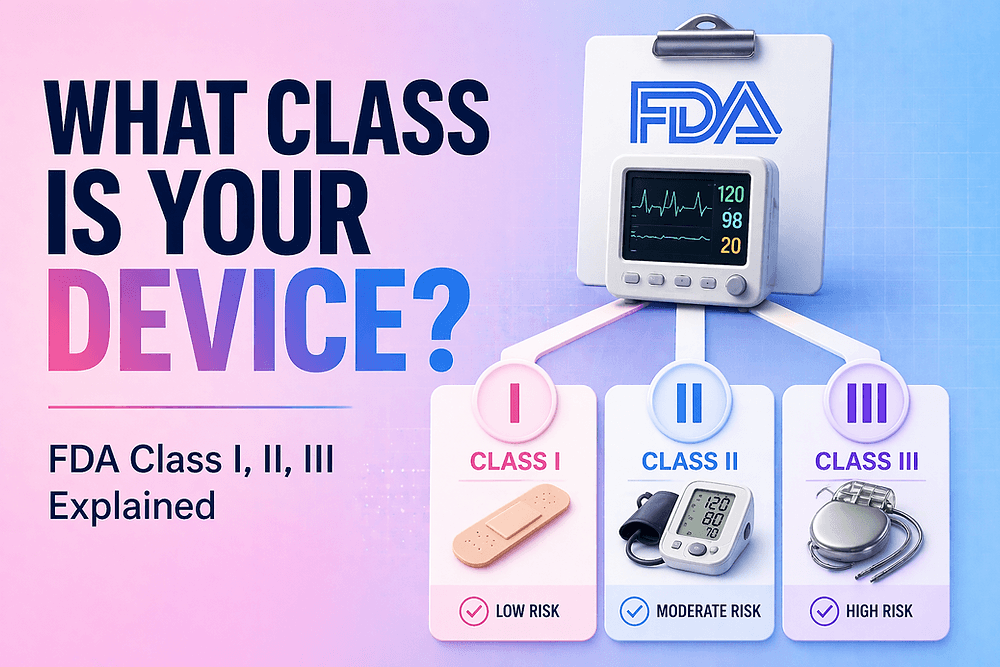
Quick answer: Your FDA medical device classification (Class I, II, or III) is based on risk and the controls needed to assure safety and effectiveness. You can usually find it by searching FDA’s Product Classification resources, then confirming the regulation number (21 CFR 862–892) and product code (3-letter code) that match your intended use and technology. FDA has classified over 1,700 generic device types across 16 medical specialty panels. Classification drives your likely pathway, for example many Class I and some Class II devices are exempt, while many Class II devices require a 510(k), and many Class III devices require PMA. If you cannot confidently match your device to an existing classification, you can submit a 513(g) Request for Information, FDA generally provides a written response within 60 calendar days, and the FY2026 user fee is $7,820 (standard) or $3,910 (small business).
Why Medical Device Classification Matters: Regulatory Pathway, Timeline, and Cost Impact
Medical device classification is not an academic exercise. It directly determines three critical business outcomes: how much your FDA pathway will cost, how long it will take, and what regulatory requirements you must meet.
Classification drives regulatory pathway:
- Class I (often exempt): If your device is exempt and your establishment is required to register and list, the typical sequence is register establishment → list device → begin commercial distribution.
- Class I (non-exempt): If your Class I device is not exempt, you may need a 510(k), plus establishment registration and listing before marketing.
- Class II: Many Class II devices require a 510(k), though some are exempt, then establishment registration and device listing before marketing.
- Class III: Many Class III devices require PMA, and some Class III devices may be marketed via other routes depending on the specific regulation and device type.
If you want to reduce “guesswork” here, the fastest approach is: confirm the likely product code and regulation number, then check what FDA has historically expected for similar devices. That is exactly where Complizen helps, it ties your intended use and core technology to likely product codes, surfaces comparable predicates, then links you to the right guidance and standards for that code.
Cost implications by classification:
Class I (often exempt):
- Establishment registration: $11,423 annually (FY2026)
- No 510(k) fee (if exempt)
- Total first-year cost: highly device-dependent, often driven by testing, labeling, and quality system readiness rather than FDA review fees
Class II (510(k) required for many devices):
- 510(k) fee: $26,067 standard or $6,517 small business (FY2026)
- Establishment registration: $11,423 annually (FY2026)
- Testing and documentation: varies widely by device type and standards scope
- Consultant fees (if used): varies widely based on scope and who drafts versus reviews
Class III (PMA required for many devices):
- PMA fee: $579,272 standard or $144,818 small business (FY2026)
- Clinical evidence and verification costs often dominate total spend, and are highly device-specific
Timeline implications by classification:
Avoid “one-size-fits-all” timelines. In practice:
- Exempt devices can be brought to market quickly if the quality system, labeling, and supply chain are ready
- 510(k) and PMA timelines vary heavily by device type, evidence requirements, and submission quality
- Higher-risk devices generally require more evidence and therefore more time
Post-market requirements differ by class:
- All classes: General controls apply. Quality system requirements under 21 CFR Part 820 (QMSR effective February 2, 2026) apply where applicable, and other obligations depend on your role (manufacturer, importer, etc.).
- Class II: General controls plus special controls (often device-specific performance/testing expectations, guidance, labeling controls).
- Class III: General controls and PMA requirements, and for PMA devices, changes often require PMA supplements and ongoing reporting.
Misclassifying your device costs money:
Example scenario: A startup assumes a wound dressing is Class I exempt, then later learns the coating or claimed antimicrobial function pushes it into a different product code with additional premarket requirements. Result: rework, added testing, and preventable timeline slip.
Bottom line: Get the product code, regulation number, and exemption status right before you invest heavily in development, tooling, or manufacturing setup.
Understanding FDA’s Three Device Classes: Risk-Based System Explained
Medical devices are assigned to one of three regulatory classes based on the level of control necessary to provide reasonable assurance of safety and effectiveness. FDA uses risk as a major factor in classification.
Class I Devices: Low Risk, General Controls
Definition: Devices for which general controls are sufficient to provide reasonable assurance of safety and effectiveness.
Risk profile: Typically low risk. Even if the device malfunctions, serious injury is less likely for many Class I device types.
Regulatory controls:
General controls (examples include):
- Establishment registration and device listing (21 CFR Part 807), where applicable to your establishment role
- Quality system requirements under 21 CFR Part 820 (QMSR effective February 2, 2026), where applicable
- Labeling requirements (21 CFR Part 801)
- Medical Device Reporting (21 CFR Part 803) requirements that apply based on your role (manufacturer, importer, user facility)
510(k) exemption: Many Class I device types are 510(k)-exempt, but exemption is device-type specific, always confirm in the FDA Product Classification system by regulation number and product code.
Examples of Class I devices can include:
- Manual surgical instruments
- Elastic bandages and gauze
- Tongue depressors
- Bed pans These examples vary by product code, always confirm the exact classification and exemptions in the Product Classification system.
Market entry pathway (for many exempt Class I devices):
- Register establishment and list device if your establishment type is required to do so
- Meet applicable general controls
- Begin commercial distribution
No FDA premarket clearance is required for exempt device types, but general controls still apply.
Exceptions: Some Class I device types are not exempt and may require 510(k). Always verify the exemption status for your specific regulation number and product code.
Class II Devices: Moderate Risk, General Controls Plus Special Controls
Definition: General controls alone are insufficient to provide reasonable assurance of safety and effectiveness, and FDA relies on special controls for many Class II device types.
Risk profile: Often moderate risk, device failure can cause harm depending on intended use and patient population.
Regulatory controls: General controls plus special controls, which can include performance standards, special labeling, and device-specific guidance.
510(k) requirement: Many Class II device types require 510(k), some are exempt. Always verify in the Product Classification system for your specific product code and regulation.
Examples of Class II devices can include:
- Many catheters
- Many infusion pumps
- Many diagnostic imaging systems Examples vary by product code.
Market entry pathway (for many Class II devices):
- Identify the correct product code and predicate strategy
- Generate required performance evidence aligned to applicable standards and guidance
- Submit 510(k) and obtain clearance
- Register and list, then commercially distribute
FY2026 510(k) user fees are published by FDA, use those values for the current fiscal year instead of hardcoding older numbers.
This is a place where teams waste weeks, product code and predicate selection drive everything downstream. Complizen helps by mapping intended use and tech characteristics to likely product codes, then pulling comparable predicates and the guidance and standards tied to that code, so you spend less time guessing and more time building the right evidence plan.
Class III Devices: High Risk, Premarket Approval Required (for many devices)
Definition: Devices that are life-supporting, life-sustaining, implantable, or present potential unreasonable risk of illness or injury, and for many Class III devices, PMA is required.
Regulatory controls: General controls plus PMA requirements. PMA often includes clinical evidence and may involve facility inspection and ongoing postmarket obligations for PMA devices.
510(k) exception: Some Class III device types have historically been marketed via routes other than PMA depending on the specific regulation and status, but you should confirm the current requirement for your regulation number and product code rather than assuming.
Examples of Class III devices can include:
- Implantable pacemakers
- Implantable defibrillators
- Ventricular assist devices Exact classification depends on product code and regulation.
Market entry pathway (PMA for many devices):
- Nonclinical testing
- Clinical evidence planning, often via IDE where applicable
- PMA submission and FDA review
- Register and list, then commercially distribute
FY2026 PMA user fees are published in FDA’s fee tables and Federal Register notices, use current FY values rather than older numbers.
De Novo alternative: For novel devices that are low-to-moderate risk but lack a predicate, De Novo may be an option.
Step-by-Step: How to Classify a Medical Device with FDA Product Codes and 21 CFR Regulations
Step 1: Search FDA Product Classification Database to Find Your Device
FDA maintains a searchable database of classified medical device types organized by product code and regulation number.
Quick Search Method: Search by Device Name
How to use:
- Go to Product Classification Database
- Enter your device common name in the “Device” field (e.g., “catheter”, “bandage”, “infusion pump”)
- Click “Submit”
- Review results
Each result typically includes:
- Device name and definition
- Product code (3-letter identifier)
- Regulation number (21 CFR section)
- Device class (I, II, or III)
- 510(k) requirement or exemption status
- Review panel / specialty area
Interpreting results:
If you find a strong match:
- Note the product code (used for registration/listing and often submission workflows)
- Note the regulation number (this is what you read in eCFR for the official classification and requirements)
- Note whether 510(k) is required or exempt
- Click the product code for more details
If you don’t find a clean match:
- Try broader terms (e.g., “implant” vs “hip implant”)
- Try related terms (e.g., “pump” vs “infusion pump”)
- Use Advanced Search filters
This is also where teams lose time because naming is inconsistent across companies and predicates. Complizen helps by letting you start from intended use and core technology, then mapping you to likely product codes and comparable cleared devices, so you are not stuck playing keyword roulette.
Advanced Search Method: Filter by Panel and Classification
When to use: device name search returns too many results or results are ambiguous
How to use:
- Click “Advanced Search”
- Select medical specialty panel (if known)
- Select device class (I, II, III)
- Select 510(k) requirement or exemption filters where available
- Add keywords if needed
- Click “Submit”
Medical specialty panels (16 total):
- 21 CFR Part 862 — Clinical Chemistry and Toxicology
- 21 CFR Part 864 — Hematology and Pathology Devices
- 21 CFR Part 866 — Immunology and Microbiology Devices
- 21 CFR Part 868 — Anesthesiology Devices
- 21 CFR Part 870 — Cardiovascular Devices
- 21 CFR Part 872 — Dental Devices
- 21 CFR Part 874 — Ear, Nose, and Throat Devices
- 21 CFR Part 876 — Gastroenterology and Urology Devices
- 21 CFR Part 878 — General and Plastic Surgery Devices
- 21 CFR Part 880 — General Hospital and Personal Use Devices
- 21 CFR Part 882 — Neurological Devices
- 21 CFR Part 884 — Obstetrical and Gynecological Devices
- 21 CFR Part 886 — Ophthalmic Devices
- 21 CFR Part 888 — Orthopedic Devices
- 21 CFR Part 890 — Physical Medicine Devices
- 21 CFR Part 892 — Radiology Devices
What if you can’t confidently map your device to a classification entry:If your device doesn’t map cleanly to an existing product code and regulation number, it may be novel or fall into a gray zone. In those cases, consider FDA interaction options such as 513(g) or De Novo, depending on risk and predicate availability.
Step 2: Understanding Regulation Numbers (21 CFR 8XX.XXXX) and What They Mean
Every classified device has a regulation number in the CFR. The key point: do not infer class from the digits. The regulation explicitly states the class in the text.
Reading the CFR Regulation TextOnce you identify your regulation number, go to eCFR to read full text:
URL format: https://www.ecfr.gov/current/title-21/chapter-I/subchapter-H/part-XXX/section-XXX.XXXX
Example: 21 CFR 870.1130
URL: https://www.ecfr.gov/current/title-21/chapter-I/subchapter-H/part-870/section-870.1130
What the regulation contains:
- (a) Identification: device name and description
- (b) Classification: device class and whether special controls apply
- (c) Additional provisions depending on device type (including exemptions and references)
Exemption Status: Reading the “.9” LimitationsMany device parts include a “.9” section describing limitations on exemptions from 510(k). If a device is listed as exempt, you still need to confirm you meet exemption limitations, especially if you modified the device in ways that could affect safety or effectiveness.
Step 3: Determining Your Product Code and Why It Matters
Product codes are 3-letter identifiers assigned by FDA to device types. They link your device to its classification regulation and are used across registration/listing and many submission workflows.
What Is a Product Code?
Definition: FDA identifier assigned to a generic device category
Used for:
- Establishment registration and device listing
- 510(k) submissions
- Import and regulatory tracking
- Postmarket reporting workflows
Relationship to classification:
- One regulation number can have multiple product codes
- Product code is often the practical handle you use day-to-day once classification is confirmed
Step 4: Using the 510(k) Database to Validate “Real-World” Comparables
If your classification search returns multiple plausible matches, the 510(k) database helps you sanity-check what similar marketed devices used.
510(k) Database URL: https://www.accessdata.fda.gov/scripts/cdrh/cfdocs/cfpmn/pmn.cfm
What to extract from relevant clearances:
- Product code
- Regulation number
- Device class
- Indications for use language
- Testing patterns and standards cited
- Predicate chains (which devices were used as predicates)
This is another place Complizen helps in practice, instead of manually stitching together product codes, predicates, and guidance, you can move from “device description” to “shortlist of comparable cleared devices plus their patterns” much faster, and you still verify everything in the official FDA databases.
Ambiguous Classification Scenarios
Scenario 1: Device Could Be Class I or Class II
Example: Surgical retractor with integrated LED lighting
Resolution approach:
- Start from intended use language, is lighting essential to safe use or a convenience feature
- Search the Product Classification Database for retractors and powered lighting device types
- Search the 510(k) database for similar retractors with lighting and extract product code and regulation number
- If classification remains ambiguous, use 513(g) or Pre-Sub to de-risk before investing in testing
Scenario 2: Device Spans Multiple Product Codes
Example: Surgical drill/saw combination device
Resolution:
- Identify primary intended use and primary mode of action
- Check if functions are separable or inseparable in real-world use
- Use cleared comparables to see how FDA treated similar “combo” configurations
- If you cannot justify a primary code cleanly, this is a strong Pre-Sub question
Scenario 3: Software Component May Change Classification Expectations
Example: Basic infusion pump plus AI dose-adjustment logic
Key questions:
- Does software control therapy delivery or meaningfully influence dosing decisions
- What is the state of the healthcare situation and the consequence of software failure
- Does the software introduce a new risk profile compared with the predicate set
Resolution approach:
- Find the closest cleared comparables and read their software and risk posture
- If software meaningfully changes risk, plan for an FDA interaction, typically Pre-Sub, before locking pathway
Scenario 4: International classification does not equal FDA classification
EU and FDA use different rule structures and decision logic. Never assume EU MDR class maps to FDA Class I, II, or III. Always determine FDA classification independently using product code, regulation number, and comparable FDA-cleared devices.
FDA 513(g) Request for Information: When and How to Submit
When classification remains uncertain after database research and you want FDA’s official written view on likely classification and applicable requirements, consider a 513(g) Request for Information.
What Is a 513(g) Request
Legal authority: Section 513(g) of the FD&C Act
Purpose: Obtain FDA’s written response on (1) the likely class/generic type your product appears to fall under and (2) the requirements that may apply, based on the information you provide
FDA response time: Within 60 days of receipt of a written request (statutory)
Cost (FY2026): $7,820 standard fee, $3,910 small business fee
Important: A 513(g) response is not a device classification decision and does not constitute FDA clearance or approval for marketing
When to Submit 513(g)
Scenarios where 513(g) makes sense:
- You cannot confidently map to an existing classification regulation
- No obvious substantially equivalent devices show up in 510(k) searches
- Database results are conflicting
- Similar devices appear under different product codes or panels
- Investors want a credible FDA-based read before funding
- The difference between likely Class II vs Class III changes the entire business case
- Paying a few thousand to reduce ambiguity can be cheaper than building the wrong plan for months
- For complex questions, FDA may recommend a 513(g) rather than back-and-forth emails
When NOT to submit 513(g)
- You already found a strong match in the Product Classification Database and multiple recent predicates align
- Your question is really about testing expectations or study design, not “what class is this,” that’s often better handled via a Q-Sub (Pre-Sub)
How to Submit 513(g)
Submission format: FDA allows voluntary use of eSTAR for 513(g) requests today. Many teams use it because it forces completeness and reduces backtracking.
Practical workflow: Use your internal research to assemble a tight device description, intended use, and rationale. Tools like Complizen can speed up the “boring but critical” part by pulling the relevant product codes, similar clearances, and FDA sources into one place so your 513(g) narrative is consistent and defensible.
What to Include (high-signal, FDA-friendly)
- Device description (what it is, how it works, key technological characteristics)
- Intended use (who, what condition, where used)
- Why classification is unclear (what you found and what conflicts)
- Your proposed classification rationale (with comparisons to the closest device types you can support)
- Supporting material (diagrams, labeling claims, and any published evidence that helps FDA understand the risk profile)
After the 513(g) Response
- Treat it as direction, not “approval”
- If it looks like a clear Class I or II device type, move into the right pathway planning
- If it’s still novel or predicate-less, you may need De Novo or a Pre-Sub to align on evidence expectations
Using Predicate Devices to Confirm and Understand Classification
If substantially equivalent devices exist, their product code and regulation number are one of the fastest ways to confirm where your device likely fits. This is not a substitute for the Product Classification Database and CFR text, but it is a high-signal shortcut when your device description maps to multiple possibilities.
Why Predicates Matter for Classification
- Predicates reveal FDA’s practical precedent: If your device matches a cleared device’s intended use and core technology, it often maps to the same product code and class, unless your changes introduce new risks or claims.
- Predicates show which product code is being used in the real world: Similar device types can appear under multiple product codes. Comparable cleared devices help you triangulate which code FDA actually uses for your configuration.
- Predicates help validate the likely pathway: If the closest comparables are consistently cleared via 510(k), that’s a signal you may be 510(k)-appropriate, assuming you can support substantial equivalence.
This is exactly where teams lose weeks, you find “similar devices,” but you are not sure which ones are truly comparable, which product code matters, and what differences reviewers actually care about. Complizen helps by pulling comparable cleared devices, their product codes, and their predicate chains into one workspace, then you verify the final call against FDA sources.
How to Use Predicates for Classification Verification
Step 1: Identify potential predicates in the 510(k) databaseSearch for devices with:
- Same intended use
- Similar core technology and mode of action
- Similar patient population and use environment
- Recent clearances can be helpful because they often reflect current expectations, but “recent” is not a rule, relevance is
Step 2: Review clearance records and extract the identifiersPull the fields that matter:
- Product code (3-letter identifier)
- Regulation number (21 CFR XXX.XXXX)
- Intended use / indications for use
- Predicate devices cited
- Testing patterns and standards referenced (useful for evidence planning)
Step 3: Compare your device to the closest comparables
Step 4: Decide whether differences change the product code or just increase evidence burden
If your device is:
- More invasive, longer duration, higher-risk population, or adds automation that changes clinical decision-making → this may increase evidence burden and in some cases can shift product code or pathway
- Substantially equivalent in intended use and core technology, with differences that can be justified with bench, software, usability, or clinical evidence → it often stays in the same product code and class, but the documentation load increases
Example: Predicate analysis for a wearable ECG monitor
Your device: Wearable ECG patch for arrhythmia detection
Comparable cleared devices (verify in the FDA database before publishing specific K-numbers):
- Most wearable ECG patch monitors map to a consistent product code and regulation, but you should confirm the exact code and CFR section from the FDA record
Your device differences:
- 21-day wear (longer duration)
- AI feature for arrhythmia detection support
Classification analysis:
- Longer wear duration often increases skin contact and usability considerations and may increase evidence expectations, but it does not automatically change class
- AI features can materially increase software documentation, validation, and cybersecurity expectations, and depending on intended use claims, can also affect product code and pathway planning
Conclusion: Device likely maps to the same product code/class as the closest cleared wearable ECG patches, assuming intended use and core technology align. The longer wear duration and AI functionality primarily impact the evidence plan and software documentation requirements. Verification approach: confirm the product code and regulation in FDA’s databases and consider a Pre-Sub if the AI claims or risk profile are novel or borderline.
Common Classification Mistakes and How to Avoid Them
After reviewing thousands of device classifications, these errors appear repeatedly.
Mistake 1: Assuming all similar devices have the same classification
Problem: “All blood glucose meters are Class II, so mine must be too.”
Reality: Classification depends on intended use, indications for use, and the specific device type FDA has already defined in regulation and product code entries.
Example:
- Glucose test systems are classified in 21 CFR 862.1345 (Class II).
Fix: Verify classification in the FDA Product Classification Database for your exact intended use and device type, not just your market category.
Mistake 2: Using outdated classification or exemption assumptions
Problem: A 2015 blog post says “Device X is Class I exempt,” so you plan accordingly.
Reality: FDA can reclassify device types and update requirements based on new information. Always verify the current classification and exemption status using FDA sources.
Fix: Use the live Product Classification Database entry as your source of truth, then confirm the regulation text in eCFR if needed.
Mistake 3: Confusing product code with classification
Problem: “My product code is KWP, so I’ve determined my classification.”
Reality: Product code points you to the FDA’s classification entry, but the entry determines class, submission type, and exemptions.
Fix: Click into the product code record, confirm class and submission type, then read the linked CFR section.
Mistake 4: Ignoring software’s impact on regulatory requirements
Problem: “The hardware is Class II, so the whole device is Class II.”
Reality: Software functions can significantly change documentation expectations and regulatory risk, especially when software influences clinical decisions or is network-connected. FDA’s CDS and SaMD frameworks emphasize intended use and risk context.
Fix: Treat software as a first-class part of classification analysis. Validate claims, intended users, and decision impact against FDA guidance and clearance precedents.
Mistake 5: Assuming CE Mark classification translates to FDA class
Problem: “Device is EU Class IIa, therefore FDA Class II.”
Reality: EU MDR and FDA classification systems use different rules and precedents. Use FDA’s Product Classification Database and 510(k) precedents to determine the US answer.
Fix: Re-do classification from scratch for FDA. Do not map EU classes to FDA classes.
Mistake 6: Missing device modifications that can trigger a new submission
Problem: You add a new feature and assume no regulatory impact.
Reality: FDA expects manufacturers to evaluate whether changes could significantly affect safety or effectiveness, and whether a new 510(k) is needed.
Fix: Before you lock scope, run a structured change assessment. This is a place where Complizen helps in practice, because teams can quickly pull the relevant product code precedents, linked guidance, and comparable cleared devices to sanity-check whether a change is likely to trigger a new submission.
Classification and Regulatory Pathway: What Happens After You Know Your Device Class
Once you determine classification, your regulatory pathway becomes much clearer. Each class has specific next steps.
Class I Exempt Devices: Direct Market Entry
Regulatory pathway:
- Verify exemption status in the 21 CFR regulation for your product code
- Confirm your device meets exemption limitations (see the “.9” limitations section for your panel)
- Register your establishment in FDA FURLS and pay the annual establishment registration fee ($11,423 for FY2026)
- List the device in FURLS, there is no separate FDA user fee for listing beyond the annual establishment registration fee
- Begin commercial distribution
Timeline: 1–3 months
Cost: $11,423 (registration) + ~$10,000 (documentation, labeling, quality system setup)
No FDA premarket clearance required, you can proceed to market after registration and listing.
Ongoing requirements:
- Annual establishment registration renewal
- Medical Device Reporting (MDR) for adverse events
- Quality system requirements under 21 CFR Part 820, now QMSR aligned with ISO 13485:2016 as of Feb 2, 2026
Class I or Class II (510(k) Required): Premarket Notification Pathway
Regulatory pathway:
- Search FDA’s 510(k) database for substantially equivalent devices
- Evaluate predicates, same intended use, similar technology, defensible comparison If you want to cut this down dramatically, this is exactly where Complizen helps, it searches FDA clearances and builds a predicate short-list with linked sources, then you validate the final choice.
- Biocompatibility (ISO 10993 series)
- Performance testing (device-specific requirements)
- Software validation (if applicable, IEC 62304)
- Electrical safety and EMC (if applicable, IEC 60601 series)
- Shelf life and packaging validation as needed
- Device description
- Indications for use
- Substantial equivalence comparison
- Test reports
- Labeling
- 510(k) summary or statement
- Submit electronically using eSTAR (required for 510(k)s submitted after Oct 1, 2023)
- Pay the FY2026 510(k) user fee: $26,067 standard, or $6,517 with FDA small business status
- Acceptance review, then substantive review
- Additional Information requests can extend timelines
- Final decision, Substantially Equivalent or Not Substantially Equivalent
- Receive your K-number
- Register establishment and list the device linked to the K-number
- Begin commercial distribution
Timeline: often 6–12 months end-to-end
Cost: commonly driven by testing and documentation plus user fees
Outcome: most 510(k)s that reach a final decision receive an SE determination, and FDA analyses have historically found NSE decisions to be a low single-digit percentage.
Class III Devices: Premarket Approval Pathway
Regulatory pathway:
- Bench and possibly animal testing
- Risk management documentation
- FDA and IRB coordination
- Study protocol and controls
- Patient enrollment and follow-up
- Safety and effectiveness evidence
- Comprehensive clinical, nonclinical, and manufacturing evidence
- Pay the FY2026 PMA user fee: $579,272 standard, or $144,818 with FDA small business status
- Electronic submission requirements vary by submission type, eSTAR is mandatory for 510(k) and De Novo, and generally optional for most other types unless FDA specifies otherwise
- Filing review
- In-depth scientific review
- Facility inspection as part of PMA review
- Advisory panel meeting for some devices
- List device with PMA number
- Register establishment, then begin commercial distribution
Timeline: commonly 2–5 years total
Cost: highly variable, often driven by clinical evidence needs
Ongoing requirements: PMA supplements for changes, annual reporting, enhanced post-market obligations
Complizen Classification Workflow Integration
Real workflow for manufacturers:
- Device profiler: Describe device intended use, technology, patient population
- Classification agent: AI determines device class, product code, regulation
- Predicates agent: AI finds substantially equivalent cleared devices, ranks by similarity
- Regulatory strategy agent: AI recommends pathway (510(k), De Novo, PMA) based on classification and predicates
- Tests agent: AI identifies required testing based on device classification and product code
- Report generation: AI compiles classification rationale with citations
Output: Defensible classification determination in 30 minutes vs 8-12 hours manual research
The Fastest Path to Market
Frequently Asked Questions
How do I know if my device is Class I, II, or III?
Search FDA’s Product Classification Database by device name or intended use. The entry shows the device type, product code, regulation number (21 CFR XXX.XXXX), and class. If you cannot find a clear match, use the 510(k) database to find close comparables as a starting point, then confirm the classification in the official classification entry.
Can a device be in multiple classes at once?
A specific marketed device, defined by its intended use, is assigned one class. However, complex systems can involve multiple components and product codes, and FDA will look at the highest-risk intended use and claims when determining what requirements apply.
What if my device is not in FDA’s Product Classification Database?
Search the 510(k) database for the closest cleared devices and extract their product code and regulation number. If your device is truly novel with no clear predicate, consider a 513(g) request or the De Novo pathway for low-to-moderate risk novel devices.
Does product code determine classification?
Product code links you to the classification regulation and database entry. The regulation number and classification entry determine the class, submission type, and exemptions.
Can FDA change device classifications over time?
Yes. FDA can reclassify device types through formal processes and will publish the details and transition provisions. Always verify your device type in the current classification entry before you commit to a pathway.
How long does a 513(g) classification request take and what does it cost?
FDA aims to respond within 60 days. For FY2026, the 513(g) fee is $7,863 standard or $1,966 small business. The response provides FDA’s written view based on the information you submit, so accuracy and completeness matter.
Can software change classification or pathway?
It can change regulatory expectations significantly depending on intended use, risk, and what decisions it supports. Validate software claims against FDA guidance and comparable cleared devices.
How often is the Product Classification Database updated?
FDA updates it regularly. The key is to treat the live database as your source of truth and avoid relying on old blog posts for exemption status.
What happens if I market under the wrong classification?
If you market a device that requires clearance or approval without it, FDA can take enforcement action and shipments can be detained at import. Fixing it usually means stopping distribution and submitting the correct premarket pathway.
Do I need to classify accessories separately?
Sometimes. Accessories can be regulated and classified separately depending on how they are marketed and used. Some accessories are exempt, others may require their own submission.