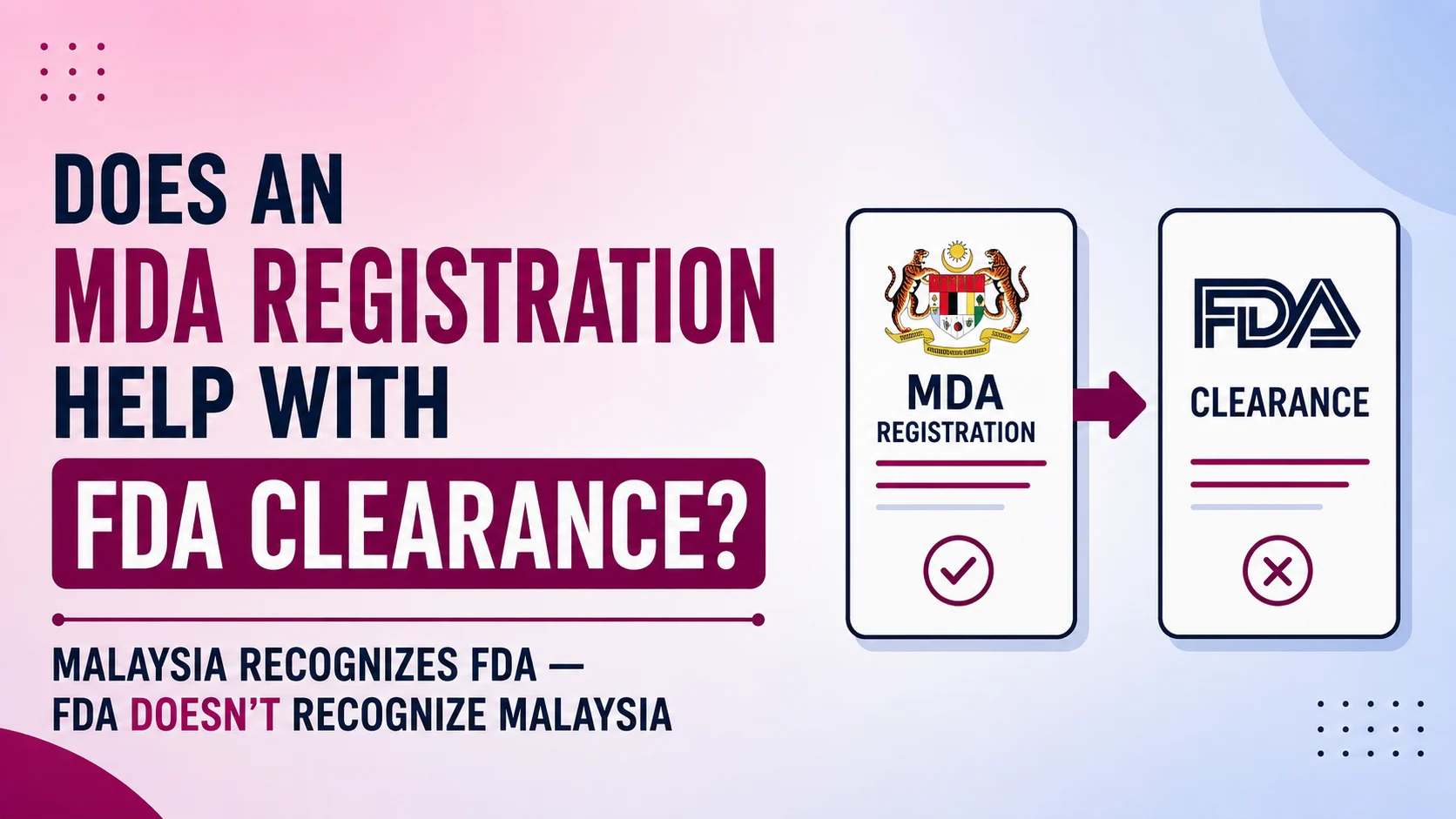
Quick Answer: An MDA registration carries no legal weight at FDA. There is no mutual recognition agreement between Malaysia and the United States for medical device product decisions, and FDA grants clearance through a 510(k), not "approval." What makes Malaysia's case worth understanding on its own terms is that the relationship genuinely runs one way: Malaysia's Medical Device Authority operates a Verification Route that explicitly recognizes US FDA clearance — alongside seven other named regulators — as grounds for a faster, lighter Malaysian review. That's real and operational. It doesn't run in reverse. FDA has no mechanism that relies on or references an MDA decision. What transfers independently of that asymmetry is the usual evidence: an ISO 13485-certified quality system substantially aligns with FDA's Quality Management System Regulation (QMSR), effective since 2 February 2026.
The relationship runs one way, and it's worth understanding why
Malaysia regulates medical devices under the Medical Device Act 2012 (Act 737), enforced by the Medical Device Authority (MDA), a statutory body established under a companion Act. Classification runs Class A through D, risk-based, broadly similar in structure to FDA's three classes but not identical in its boundaries — as with any foreign classification system, it has to be confirmed independently against FDA's own product code database, not inferred from your Malaysian file. If you're weighing this against a European or other Asian file, what actually transfers from a CE Mark to a 510(k) works through the same underlying logic — evidence transfers, status doesn't.
Here's what makes Malaysia genuinely different from that general rule, and worth stating precisely because it's easy to overinterpret. MDA operates a Verification Route — an abridged conformity assessment pathway for devices that already hold approval from a recognized reference authority. As of MDA's current guidance (MDA/GD/0068, Second Edition), that list names eight authorities: the US FDA, EU Notified Bodies, Japan's MHLW, Australia's TGA, Health Canada, the UK's MHRA, Singapore's HSA, and Thailand's FDA. A device already cleared by FDA can move through Malaysian registration via a Conformity Assessment Body verification review rather than a full technical assessment — a real, published, operational mechanism, not a general goodwill gesture.
What it is not is mutual. Malaysia's decision to rely on FDA doesn't create any obligation, expectation, or mechanism for FDA to rely on Malaysia. Nothing about MDA's Verification Route gives a Malaysian manufacturer's own MDA registration any standing in a 510(k) review. This is a pattern worth internalizing beyond this one case: reliance in medical device regulation typically flows from newer or smaller regulatory systems toward more established ones, not symmetrically between them. Malaysia relying on FDA is a sign of a well-functioning, pragmatic regulatory system — it just doesn't tell you anything about what FDA will do with a Malaysian file, because that's a different question entirely.
The asymmetry now extends beyond MDA's own guidance into trade policy, and it's worth being precise about exactly what changed. On 26 October 2025, Malaysia and the United States signed the Agreement on Reciprocal Trade (ART), and as part of addressing non-tariff barriers, Malaysia committed to accepting FDA certificates and prior marketing authorizations for medical devices and pharmaceuticals, along with a specific commitment not to require Malaysian market authorization for low-risk devices where FDA itself doesn't require one. That's a real, signed, government-to-government commitment — and MDA moved quickly to clarify its limits in its own public statement: acceptance of US FDA approvals does not mean automatic market entry, and devices must still be registered with MDA to confirm safety, quality, and compliance with local requirements. In other words, the trade agreement formalizes and reinforces the same Verification Route mechanism already described above; it doesn't create a separate, faster lane, and it doesn't touch what happens in the other direction. A trade agreement branded "reciprocal" still produced a one-directional regulatory commitment here — Malaysia recognizing FDA, with nothing equivalent obligating FDA to recognize MDA.
What genuinely transfers: your quality system
The Quality Management System Regulation took effect on 2 February 2026 and incorporates ISO 13485:2016 by reference into 21 CFR Part 820. If your quality system is ISO 13485-certified, it now substantially aligns with FDA's expectations — the same shift covered in full in our ISO 13485 guide and QMSR breakdown. The usual caution applies: a certificate is not accepted in lieu of an FDA inspection. An MDSAP audit report is.
MDA became an MDSAP Affiliate Member effective 16 September 2025, recognized by the program's Regulatory Authority Council — MDA's own announcement confirms the date directly. That puts Malaysia in the same participation tier as several other regulators navigating this cluster of questions, and the same nuance applies as elsewhere: MDSAP audits the manufacturer, not the manufacturer's home regulator. Any manufacturer, Malaysian or otherwise, can pursue an MDSAP audit through a recognized Auditing Organization, and if FDA is included in that audit's scope, FDA — as one of MDSAP's five full Members, alongside Australia, Brazil, Canada, and Japan — accepts the report as a substitute for routine surveillance inspections. That has nothing to do with MDA's own membership tier. MDA's Affiliate status describes something separate: it means MDA itself now accepts MDSAP reports and certificates as QMS evidence for Malaysian establishment licensing and device registration, which is a genuine domestic benefit, just not one that reaches back to FDA.
Testing: SAMM accreditation is real, not an FDA pathway
Malaysia's national laboratory accreditation body, SAMM (Skim Akreditasi Makmal Malaysia), operates under the Department of Standards Malaysia and accredits labs to ISO/IEC 17025, with recognition through the ILAC Mutual Recognition Arrangement. That's genuine, internationally recognized technical competence — the same structural credibility NABL carries in India or KOLAS carries in Korea.
It isn't a formal FDA recognition scheme either. FDA doesn't maintain a list of accredited foreign lab-accreditation bodies whose stamp guarantees data acceptance. What matters to FDA review is whether your testing followed the FDA-recognised version of the relevant standard — ISO 10993 for biocompatibility, IEC 60601 for electrical safety — on your finished device, with complete documentation. A SAMM-accredited lab is well-positioned to produce exactly that kind of data; confirming the specific tests, standard versions, and endpoints actually match what your predicate and product code require is a separate exercise worth doing deliberately, and it's the kind of gap analysis Complizen's Superagent platform is built to run against your actual file.
Your predicate has to be American, regardless of what MDA recognized
Whatever route your device took into the Malaysian market — full conformity assessment or the Verification Route via an existing FDA clearance — none of it substitutes for choosing a US predicate device. FDA's substantial equivalence comparison requires a device already legally marketed in the United States. Nothing about Malaysian registration status, however it was obtained, changes that requirement or narrows the search for you.
Two different in-country roles, two different regulators
Malaysia requires foreign manufacturers to appoint a Local Authorised Representative (LAR) for MDA purposes. FDA separately requires a US Agent for any foreign manufacturer distributing in the United States. These are two roles serving two regulators, and having a LAR in place for Malaysia does nothing for your FDA obligations. As with any foreign manufacturer, US Agent designation and establishment registration are conditions of commercial distribution, not of 510(k) clearance.
What it costs at FDA in FY2027
FDA fees don't vary by country of origin. In FY2027, running 1 October 2026 through 30 September 2027: a standard 510(k) is $28,653, or $7,163 with small business status; annual establishment registration is $13,785, with no small business reduction. Malaysian manufacturers qualify for small business status the same way any foreign manufacturer does — through a National Taxing Authority Certification rather than a US tax return, bearing the official seal of Malaysia's Inland Revenue Board and confirming gross receipts in both local currency and US dollars. FDA requires this at least 60 days before the fee is due and won't refund the difference if you pay standard and qualify later.
Two clocks, and one of them doesn't apply to you yet
MDA's Verification Route exists to speed up the other direction of this relationship — an FDA-cleared device entering Malaysia, not a Malaysian device entering the US. If you're a Malaysian manufacturer without existing FDA clearance, there's no MDA-side acceleration available to you for a first US submission, because the mechanism that benefits you is built for after you already have one.
FDA's MDUFA V goal is a decision within 90 FDA days for 95% of 510(k) submissions. "FDA days" and calendar days aren't the same thing — the clock pauses whenever FDA is waiting on you, most commonly during an Additional Information request. Whatever MDA's own review timelines look like for your device (full conformity assessment or otherwise), they're unrelated to FDA's clock in either direction. Budget them independently.
Common mistakes
Assuming MDA's reliance-friendly reputation means the relationship is mutual. Malaysia's Verification Route recognizes FDA. FDA has no equivalent mechanism recognizing MDA.
Expecting the Verification Route to speed up a first-time FDA submission. It accelerates Malaysian entry for devices that already hold FDA clearance — not the reverse.
Treating MDA's MDSAP Affiliate status as country-level reciprocity. What actually matters for FDA acceptance is whether your own manufacturer-level MDSAP audit included FDA in scope, independent of MDA's own membership tier.
Confusing a Local Authorised Representative with a US Agent. Two roles, two regulators, no substitution.
Registering a US establishment before there's a US buyer. It's a distribution requirement, not a submission requirement, and it starts an annual fee for no immediate benefit.
Frequently asked questions
Does an MDA registration help with FDA clearance? Not as a credential — there's no mutual recognition agreement between MDA and FDA for product decisions, and an MDA registration has no legal standing at FDA. The relationship actually runs the other direction: MDA's own Verification Route recognizes US FDA clearance as grounds for an abridged Malaysian review, but that recognition doesn't flow back to FDA.
Does FDA recognize MDA approvals? No. FDA has no mechanism that relies on or references MDA decisions. This is a real asymmetry, not an oversight — Malaysia's Verification Route names FDA as one of eight recognized reference authorities for its own abridged review pathway, but nothing obliges or enables FDA to reciprocate.
What is Malaysia's MDA Verification Route? An abridged conformity assessment pathway for devices that already hold approval from a recognized reference regulator. As of MDA's current guidance, that list includes the US FDA, EU Notified Bodies, Japan's MHLW, Australia's TGA, Health Canada, the UK's MHRA, Singapore's HSA, and Thailand's FDA. Devices with qualifying approval undergo a verification review by a Malaysian Conformity Assessment Body rather than a full technical assessment.
Is MDA an MDSAP member? MDA became an MDSAP Affiliate Member effective 16 September 2025, per the program's Regulatory Authority Council. That's a different, narrower tier than the program's five full Members — Australia, Brazil, Canada, Japan, and the US. It mainly governs how MDA itself uses MDSAP for Malaysian domestic purposes, and doesn't change whether FDA accepts an MDSAP audit for a Malaysian manufacturer — that depends on whether FDA was included in the audit's own scope.
Will FDA accept test data from a SAMM-accredited Malaysian lab? It can, on the same basis as testing from any lab anywhere. SAMM accreditation under ISO/IEC 17025, recognised through the ILAC Mutual Recognition Arrangement, is a genuine quality signal. FDA's acceptance depends on whether the specific test followed the FDA-recognised standard and version for your device type with complete documentation — not on which national body accredited the lab.
Do I need a US Agent if I already have a Local Authorised Representative for MDA? Yes, separately. An LAR satisfies MDA's requirement for a locally based responsible party in Malaysia. FDA requires its own US Agent for any foreign manufacturer distributing in the United States. Neither substitutes for the other.
What does FDA clearance cost for a Malaysian manufacturer? The same published fees as any manufacturer. In FY2027, a standard 510(k) is $28,653, or $7,163 with small business status, plus $13,785 for annual establishment registration. Malaysian manufacturers qualify for small business status through a National Taxing Authority Certification from Malaysia's Inland Revenue Board rather than a US tax return.
If my device already has an MDA registration, does that help with my US predicate search? No. FDA's substantial equivalence requirement is for a device already legally marketed in the United States, regardless of how your device was registered in Malaysia. An MDA registration, however it was obtained, doesn't narrow or inform that search.
Why does Malaysia recognize FDA but FDA doesn't recognize Malaysia? This isn't specific to Malaysia — reliance relationships between regulators are typically asymmetric, running from newer or less internationally established systems toward larger, longer-standing ones. Malaysia's willingness to rely on FDA (among seven other named authorities) reflects a pragmatic, efficiency-minded regulatory posture. It doesn't create a reciprocal obligation, and none currently exists.
Does Malaysia have similar reliance arrangements with other countries besides the US? Yes. Malaysia's MDA also has active reliance arrangements with Singapore's HSA (permanently confirmed March 2026) and a pilot programme with Thailand's FDA running through April 2026, alongside a proposed four-country ASEAN single-submission framework. All of these follow the same logic as the FDA relationship: they speed up entry into Malaysia for devices already approved elsewhere, not the reverse.
Does the Malaysia-US trade agreement mean FDA-cleared devices get automatic entry into Malaysia? No, and MDA has said so explicitly. The Agreement on Reciprocal Trade, signed 26 October 2025, commits Malaysia to accepting FDA certificates and prior marketing authorizations for medical devices as part of addressing non-tariff barriers. MDA clarified publicly that this does not mean automatic market entry — devices must still be registered with MDA. The agreement reinforces the existing Verification Route rather than replacing it, and creates no reciprocal obligation for FDA.
Key takeaways
The relationship is real but one-directional — now written into trade policy, not just regulatory guidance. MDA's Verification Route names FDA as a recognized reference authority, and the October 2025 US-Malaysia trade agreement formalizes Malaysia's acceptance of FDA approvals. FDA has no equivalent mechanism for MDA decisions, and MDA itself has publicly confirmed this doesn't mean automatic market entry.
QMSR is the genuine cross-cutting advantage, if you hold ISO 13485. Since February 2026, your quality system substantially aligns with FDA's expectations — though a certificate still isn't accepted in lieu of inspection the way an MDSAP report is.
MDSAP Affiliate status is about Malaysia's own domestic acceptance, not FDA reciprocity. What matters at FDA is whether your own manufacturer-level MDSAP audit included FDA in scope.
The Verification Route can't accelerate a first FDA submission. It's built for devices that already hold FDA clearance entering Malaysia — not the reverse.
Two regulators, two local roles, two independent clocks. An LAR isn't a US Agent, and MDA's review timelines have no bearing on FDA's MDUFA V goals.
Complizen helps international medical device manufacturers reach FDA 510(k) clearance, combining a software platform for in-house regulatory teams with full-service consultancy for teams without in-house FDA expertise.
Working out which parts of your existing regulatory file genuinely carry weight at FDA — rather than assuming Malaysia's reliance-friendly posture runs both ways — is the highest-leverage call to get right early. Complizen's regulatory strategy engagement maps your device to a US pathway, product code, and predicate shortlist, reviewed by a senior FDA expert. See how the strategy service works →
References
- FDA — Quality Management System Regulation (QMSR). https://www.fda.gov/medical-devices/postmarket-requirements-devices/quality-management-system-regulation-qmsr
- FDA — Medical Device Single Audit Program (MDSAP). https://www.fda.gov/medical-devices/cdrh-international-affairs/medical-device-single-audit-program-mdsap
- FDA — MDUFA Performance Goals and Procedures, Fiscal Years 2023 Through 2027. https://www.fda.gov/media/73507/download
- Federal Register — Medical Device User Fee Rates for Fiscal Year 2027. https://www.federalregister.gov/documents/2026/07/30/2026-15335/medical-device-user-fee-rates-for-fiscal-year-2027
- Medical Device Authority (MDA) Malaysia — Announcement: Recognition of MDA as an Affiliate Member of MDSAP. https://portal.mda.gov.my/index.php/announcement/1642-announcement-update-recognition-of-the-medical-device-authority-mda-as-an-affiliate-member-of-the-medical-device-single-audit-program-mdsap-and-utilization-of-mdsap-reports-and-certificates
- Emergo by UL — The Medical Device Authority in Malaysia Releases Second Revised Guidance on Expanded Recognition Framework (secondary source; regulatory consultancy, citing MDA/GD/0068 Second Edition). https://www.emergobyul.com/news/medical-device-authority-malaysia-releases-second-revised-guidance-expanded-recognition
- OMC Medical — Malaysia Updates Verification Pathway Guidance for Medical Device Registration in MeDC@St (secondary source; regulatory consultancy). https://omcmedical.com/news/malaysia-mda-updates-verification-pathway
- Department of Standards Malaysia (JSM) — Skim Akreditasi Makmal Malaysia (SAMM). https://www.jsm.gov.my/component/content/article/252-skim-akreditasi-makmal-malaysia-samm?catid=12&Itemid=448
- RAPS — Asia-Pacific Roundup: Malaysia's MDA joins MDSAP as affiliate member (secondary source; industry publication). https://www.raps.org/resource/asia-pacific-roundup-malaysia-s-mda-joins-mdsap-as.html
- Health Sciences Authority (Singapore) — Regulatory Reliance overview, including the Malaysia MDA reliance programme. https://www.hsa.gov.sg/international-collaboration/md/regulatory-reliance/
- The White House — Agreement Between the United States of America and Malaysia on Reciprocal Trade (full text), 26 October 2025. https://www.whitehouse.gov/briefings-statements/2025/10/agreement-between-the-united-states-of-america-and-malaysia-on-reciprocal-trade
- The White House — Joint Statement on United States-Malaysia Agreement on Reciprocal Trade, 26 October 2025. https://www.whitehouse.gov/briefings-statements/2025/10/joint-statement-on-united-states-malaysia-agreement-on-reciprocal-trade/
- Medical Device Authority (MDA) Malaysia — Press Release: Malaysia-United States Agreement on Reciprocal Trade, a Landmark Achievement for the Medical Device Sector. https://portal.mda.gov.my/index.php/announcement/1698-press-release-malaysia-united-states-agreement-on-reciprocal-trade-a-landmark-achievement-for-the-medical-device-sector
- CodeBlue — No Automatic Market Entry For US Medical Devices: MDA (secondary source; Malaysian health policy journalism, quoting MDA directly). https://codeblue.galencentre.org/2025/10/no-automatic-market-entry-for-us-medical-devices-mda/