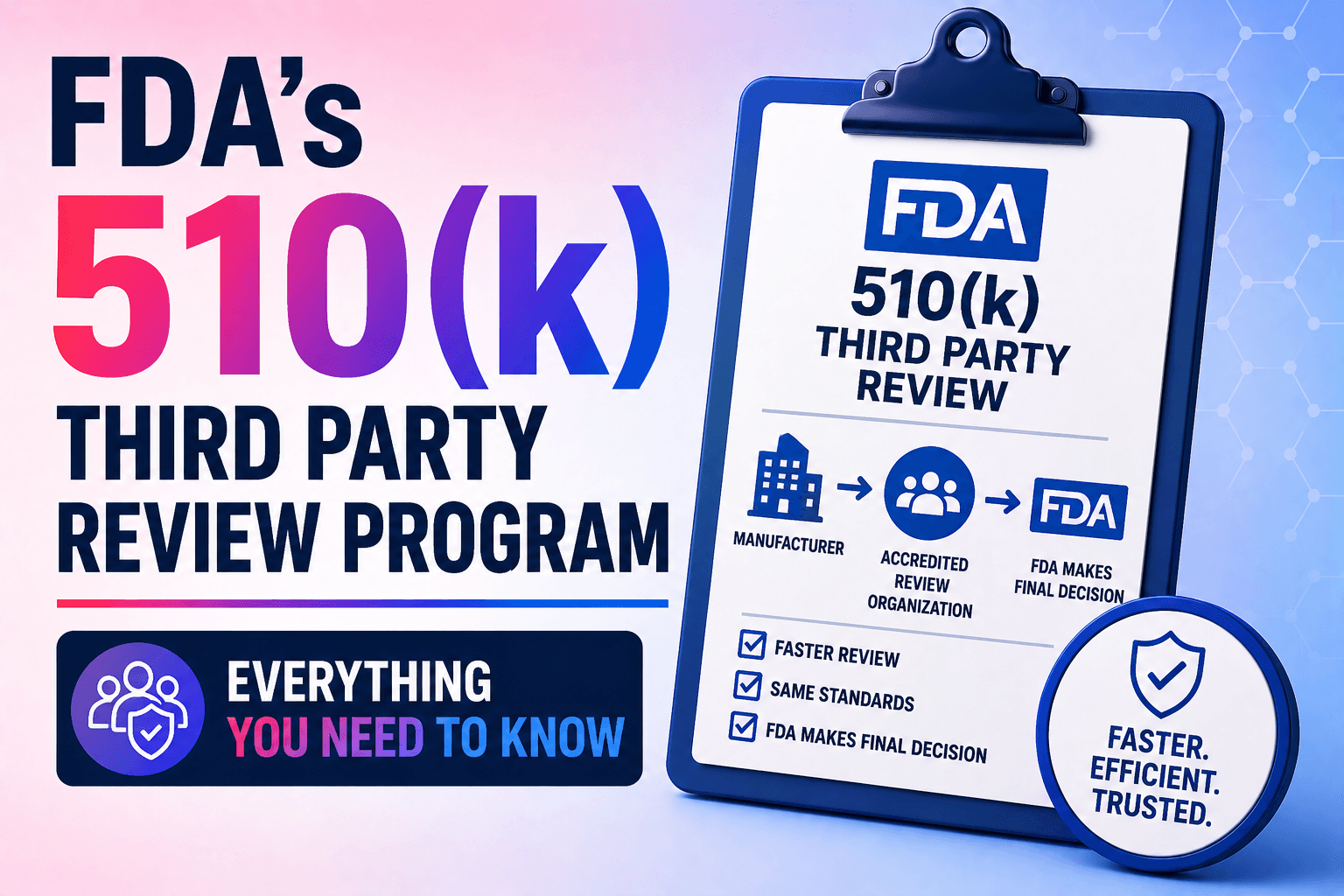
Quick answer: FDA's 510(k) Third Party Review Program — formally called the Accredited Persons Program — lets manufacturers of certain low-to-moderate risk devices submit their 510(k) to an FDA-recognized third-party review organization instead of directly to FDA [1]. The review organization applies the same substantive criteria FDA would use, then forwards its review and a recommendation (Substantially Equivalent or Not Substantially Equivalent) to FDA, which has a MDUFA review timeframe of 30 days after receiving that recommendation [1]. FDA states that approximately half of the 510(k)s it receives are eligible for this program [1]; the precise number of eligible product codes can shift as FDA updates its eligibility database. The most overlooked benefit: submissions reviewed under this program are exempt from FDA's standard 510(k) user fee — the only payment is between the submitter and the review organization directly [1]. As of FDA's most recently updated accreditation list, nine organizations are currently recognized to conduct these reviews [4]. Participation is entirely voluntary, and eligibility must be confirmed at the specific product-code level, not assumed from device class alone.
What the Third Party Review Program Actually Is
The program is authorized under Section 523 of the Federal Food, Drug, and Cosmetic Act, which directs FDA to recognize qualified third parties to conduct the initial review of 510(k) submissions for certain low-to-moderate risk device types [3]. FDA's official name for it is the Accredited Persons Program; nearly everyone in the industry calls it "3P510k" for short.
The core idea: FDA doesn't have unlimited reviewer capacity, and a large share of 510(k) submissions involve well-established, lower-risk device types with predictable review criteria. Rather than have FDA's own reviewers spend time on every one of these, FDA recognizes qualified outside organizations to do the initial technical review, using the identical decision criteria FDA itself would apply [1]. The program is intended to allow FDA to focus more of its own resources on higher-risk, more complex submissions [1].
What this program is NOT:
- It is not a way to get a "third-party clearance" instead of an FDA clearance — FDA retains sole legal authority to clear or not clear any device [1]
- It is not eligible for PMA (Premarket Approval) submissions — only 510(k)s
- It is not available for every device type — eligibility is determined by a published FDA list, not by manufacturer preference
- It is not a way to appeal or bypass a prior FDA "Not Substantially Equivalent" decision — a device previously found NSE by FDA must be resubmitted directly to FDA, not through the third party pathway
How the Process Actually Works
FDA publishes a five-step overview of the third-party review pathway [1]:
Step 1: The manufacturer submits the 510(k) to an accredited review organization rather than directly to FDA. You engage an FDA-recognized 3P510k Review Organization and submit your complete 510(k) package to them as the initial recipient.
Step 2: The Review Organization conducts its review. This includes the same substantive analysis FDA itself would perform — evaluating your device description, predicate comparison, and testing data against the applicable regulatory criteria and recognized standards [1]. The review organization may request additional information from you if the submission is incomplete, exactly as FDA would through an Additional Information request. It may also interact early with FDA to confirm it's applying current standards and guidance for that specific device type [1].
Step 3: The Review Organization forwards the full package and its recommendation to FDA. Once satisfied with its review, the organization sends FDA the complete original 510(k) submission, its own documented review, and a recommendation of either Substantially Equivalent (SE) or Not Substantially Equivalent (NSE) [1].
Step 4: FDA reviews the recommendation and makes the final decision. FDA is not required to independently re-review the entire submission — the agency has specifically moved toward eliminating routine re-review of 510(k)s already reviewed by a 3P510k Review Organization, in order to preserve the speed benefit of the program [1]. However, if FDA identifies concerns with the third party's application of the decision criteria or with the review documentation, FDA may seek clarification or conduct additional review where necessary [1].
Step 5: FDA informs the Review Organization, and the Review Organization informs you. The clearance decision flows back through the same channel it came through.
The regulatory clock: FDA's MDUFA (Medical Device User Fee Amendments) performance goal is to issue its decision within 30 days after receiving the review organization's recommendation [1]. This is a performance goal, not a guarantee, and the window applies specifically to FDA's portion of the process — the review organization's own review time before that point varies by organization and submission complexity. Individual review organizations may advertise target review periods for complete, straightforward submissions; these are organization-specific commercial estimates, not FDA program deadlines.
Is Your Device Eligible? How to Actually Check
Eligibility is device-specific, not manufacturer-specific, and it's published, not discretionary.
The Eligibility List
FDA maintains a publicly searchable list of device types eligible for third-party review, organized by medical specialty panel and classification regulation number (21 CFR Parts 862-892) [5]. The list identifies eligible devices by:
- Classification regulation number (e.g., 21 CFR 862.1345)
- Classification name (the generic device type description)
- Device class (only Class I and Class II devices appear on this list — Class III devices requiring PMA are categorically excluded)
- Applicable recognized standards that both manufacturers and review organizations should reference
Where to check: FDA's device-eligibility database is organized by medical specialty panel (cardiovascular, orthopedic, general hospital, etc.) and is updated regularly. FDA specifically directs manufacturers to confirm eligibility at the product-code level — different product codes can sit under the same classification regulation and may have different eligibility or organizational coverage. Rather than assuming your device type is or isn't eligible based on classification alone, look up your specific product code directly.
Key Exclusions Worth Knowing
Submissions associated with a prior Not Substantially Equivalent determination require care. FDA's current third-party-review guidance contains exceptions affecting submissions tied to prior NSE determinations. There's an important distinction between a device type having historical NSE decisions elsewhere, versus the same submission or device having previously received an NSE determination, versus a new submission involving material changes after an NSE decision. Evaluate the specific facts against FDA's current guidance, or confirm directly with FDA and your prospective review organization, rather than assuming a blanket prohibition applies.
PMA submissions are categorically ineligible. The program applies only to eligible devices that require a 510(k) — generally devices within Class I and Class II. Devices requiring Premarket Approval are not eligible. It's worth noting that many Class I devices are already exempt from 510(k) requirements entirely, meaning there's no 510(k) to route through a third party in the first place — the practical pool of eligible devices skews toward Class II and the smaller subset of non-exempt Class I devices.
Not every device within an eligible classification is automatically eligible. FDA's guidance includes specific exceptions to the general list for certain device types within otherwise-eligible classifications — always verify against the current published exceptions rather than assuming a classification-level eligibility applies to every device configuration.
Roughly half of all submitted 510(k)s are eligible. FDA's own published figure is that approximately 50% of 510(k)s the agency receives are eligible for this program [1]. The exact number of eligible product codes can change as FDA updates the underlying database, so treat any specific device-count figure as a snapshot rather than a fixed total.
The Currently Recognized Third-Party Review Organizations
As of FDA's most recently updated accreditation database, nine organizations are recognized under the 510(k) Third Party Review Program [4]:
AABB — Historically associated with blood banking and transfusion medicine expertise, AABB is recognized to review eligible devices within its designated scope of product codes.
Beanstock Consulting — A recognized review organization covering its designated eligible device types.
Center for Measurement Standards of Industrial Technology Research Institute — A recognized review organization with a specific scope of eligible product codes.
COLA, Inc. — Historically associated with laboratory accreditation and clinical diagnostics expertise.
Global Quality and Regulatory Services (GQRS) — A recognized review organization covering its designated eligible device types.
Regulatory Technology Services, LLC — A recognized review organization covering its designated eligible device types.
Scarlet NB B.V. — A recognized review organization covering its designated eligible device types.
SMO India — A recognized review organization covering its designated eligible device types.
Third Party Review Group, LLC (TPRG) — A recognized review organization; the organization's own published materials cite a target review turnaround of approximately 10-15 days for complete, eligible submissions before forwarding a recommendation to FDA. This is TPRG's own commercial estimate, not an FDA program deadline or a guaranteed total time to clearance.
Recognition does not mean any organization can review every eligible device. Each organization's FDA listing identifies the specific product codes it is authorized to review — not the full eligible device list [4]. Before engaging any review organization, confirm both that your device's product code is on FDA's eligible list, and that your chosen organization's current scope specifically includes that product code.
A cautionary historical note: Accelerated Device Approval Services, LLC (ADAS) was previously a recognized review organization but FDA withdrew that recognition effective August 13, 2021 [4]. Accreditation status and scope can change — always verify current status directly against FDA's live accreditation list before engaging any organization, rather than relying on older directories, cached pages, or outdated marketing materials.
The Cost Structure: What Most Manufacturers Get Wrong
This is the least understood part of the program, and it's a genuinely valuable point.
There is no separate FDA user fee for submissions reviewed under the third-party program. FDA's own guidance is explicit: "the sole payment under the program is between the 510(k) submitter and the 3P510k Review Organization; there is no separate payment (i.e., user fee) to the FDA" [1].
What this means practically: Under the standard direct-to-FDA 510(k) pathway, you pay FDA's standard user fee (FY2026, October 1, 2025 through September 30, 2026: $26,067 standard, $6,517 small business) plus any consultant or internal costs for preparing the submission. Under the third-party pathway, you instead pay the review organization's fee — negotiated directly between you and that organization — and you are exempt from FDA's standard 510(k) user fee.
Why this matters for planning: Whether the third-party pathway is actually cheaper overall depends entirely on how the review organization's fee compares to FDA's standard user fee plus any speed-related savings. Review organization fees are set independently by each organization and are not published in a standardized fee schedule the way FDA's user fees are — you need to request pricing directly from the organization you're considering.
What doesn't change: Your underlying testing costs (biocompatibility, performance, electrical safety), documentation preparation costs, and any regulatory consultant fees you use to prepare the submission itself are the same regardless of which review pathway you choose. The third-party program changes who reviews your submission and what you pay for that specific review step — it doesn't reduce the underlying work of preparing a complete, defensible 510(k).
Why Manufacturers Choose (or Skip) This Pathway
Reasons to Use Third-Party Review
Potential speed advantage for well-prepared submissions. Because review organizations often have more concentrated bandwidth for specific device types within their accredited scope, and because the review organization's own process can run in parallel with less queue time than FDA's general submission backlog, some manufacturers see faster overall time-to-decision — though this depends heavily on the specific review organization's current capacity and your submission's completeness.
Specialized technical expertise. Some review organizations (like AABB for blood-banking-related devices, or COLA for clinical diagnostics) bring deep, specialty-specific technical expertise that can result in a more efficient review for devices squarely within their specialization.
No separate FDA user fee. As detailed above, this can be a genuine cost consideration depending on the review organization's fee structure.
Reasons Manufacturers Skip It
Narrow accreditation scope. If your device's specific product code isn't covered by any currently accredited organization's scope, the pathway simply isn't available to you regardless of the general eligibility list.
Fee uncertainty. Because review organization fees aren't standardized or published the way FDA's fees are, some manufacturers find it harder to budget confidently in advance.
Familiarity and direct FDA relationship. Manufacturers who've already been through direct FDA submissions, or who anticipate needing early informal interaction with FDA reviewers (such as through a Pre-Submission meeting), sometimes prefer maintaining that direct relationship rather than routing through an intermediary.
FDA can still request re-review. While FDA has moved to reduce routine re-review of third-party-reviewed submissions, the agency retains authority to require it if quality issues arise [1] — meaning the theoretical worst case (a flawed third-party review triggering a full FDA re-review) still exists, even if uncommon in practice.
Common Misconceptions
Misconception 1: "Third-Party Review Means I Don't Need FDA's Approval"
Reality: FDA retains full and sole legal authority to clear or not clear your device. The review organization only makes a recommendation; FDA makes the binding determination [1]. Marketing your device before receiving FDA's own clearance letter — even if the review organization's recommendation was favorable — is not permitted.
Misconception 2: "Any Recognized Organization Can Review My Device"
Reality: Each review organization is recognized for specific product codes, not the entire eligible device list. An organization recognized for cardiovascular devices cannot review your orthopedic device just because it holds "3P510k Review Organization" status generally [4]. Always confirm product-code-specific scope before engaging.
Misconception 3: "This Pathway Is Always Faster"
Reality: Speed depends on the specific review organization's current capacity, your submission's completeness, and device complexity — not an inherent guarantee of the pathway itself. A poorly prepared submission will face Additional Information requests under either pathway, third-party or direct-to-FDA. A review organization's advertised turnaround estimate is a commercial estimate from that organization, not an FDA performance goal.
Misconception 4: "I Still Have to Pay FDA's Standard User Fee on Top of the Review Organization's Fee"
Reality: This is specifically not the case. FDA's guidance directly states there is no separate FDA user fee under this program — only payment to the review organization [1]. Confirming this with your chosen review organization in writing before engaging is still good practice, since fee structures can evolve.
Misconception 5: "My Device Type Being Class II Automatically Means It's Eligible"
Reality: Eligibility must be confirmed at the specific product-code level against FDA's published eligibility database — not assumed from device class alone [1]. Many Class II product codes are NOT on the eligible list, particularly where FDA has determined the device type warrants its own direct review due to complexity or risk profile within that class.
How This Fits Into Your Overall Regulatory Strategy
If you're an international manufacturer evaluating your first 510(k) submission, the third-party review question should come up early in your strategy — but it's a secondary decision, not a primary one.
Sequence that makes sense:
- First, determine your device classification and confirm 510(k) is your correct pathway (as opposed to De Novo or PMA)
- Second, identify your predicate devices and confirm substantial equivalence is achievable
- Third, check your specific product code against FDA's third-party eligibility list
- Fourth, if eligible, identify which currently accredited organizations cover your specific product code
- Fifth, request fee and timeline quotes from those organizations and compare against the standard direct-to-FDA pathway, factoring in FDA's standard user fee, typical FDA queue times for your device type, and your own internal timeline pressures
A practical note: Because review organization accreditation scope and status can change (as the ADAS example shows), this check should happen close to your actual submission timing, not months in advance based on older information.
Frequently Asked Questions
What is FDA's 510(k) Third Party Review Program formally called?
The Accredited Persons Program, authorized under Section 523 of the Federal Food, Drug, and Cosmetic Act [3]. "510(k) Third Party Review Program" and "3P510k" are the commonly used informal names for the same program.
Does using a third-party review organization mean I skip FDA entirely?
No. The review organization conducts the initial substantive review and forwards a recommendation, but FDA retains full legal authority to make the final clearance decision, typically within 30 days of receiving that recommendation [1]. Your device is not legally cleared until FDA itself issues that determination.
How do I know if my device is eligible for third-party review?
Check your device's classification regulation number and product code against FDA's published list of eligible devices, organized by medical specialty panel [5]. Eligibility is determined by device type, not manufacturer size or location, and only Class I and Class II devices are eligible — PMA devices are categorically excluded.
Do I still pay FDA's standard 510(k) user fee if I use a third-party review organization?
No. FDA's guidance is explicit that there is no separate FDA user fee under this program — the only payment is between you and the review organization directly [1]. This is one of the most commonly misunderstood aspects of the program. FDA's standard 510(k) fee for FY2026 is $26,067 ($6,517 for a qualified small business) — that fee simply doesn't apply when your submission goes through a recognized third-party review organization.
How many organizations are currently recognized to conduct third-party reviews?
Nine organizations appear on FDA's current accreditation list: AABB, Beanstock Consulting, Center for Measurement Standards of Industrial Technology Research Institute, COLA Inc., Global Quality and Regulatory Services, Regulatory Technology Services LLC, Scarlet NB B.V., SMO India, and Third Party Review Group LLC [4]. Each is recognized for specific product codes, not the full eligible device list, and this list can change — always verify current status directly.
Can a device previously rejected by FDA be resubmitted through third-party review?
FDA's current guidance contains exceptions affecting submissions tied to prior Not Substantially Equivalent determinations. The specifics depend on whether it's the same submission, the same device with changes, or a different device within a historically NSE-prone type — evaluate the exact facts against current FDA guidance, or confirm directly with FDA and your prospective review organization, rather than assuming a blanket rule.
Is third-party review always faster than submitting directly to FDA?
Not guaranteed. Speed depends on the specific review organization's current capacity and your submission's completeness. Individual review organizations may advertise target review periods for complete submissions — for example, one organization cites approximately 10-15 days — but these are organization-specific commercial estimates, not FDA program deadlines. FDA's own 30-day performance goal for its final decision applies regardless of which review organization delivered the recommendation.
Can FDA overturn or require re-review of a third-party review organization's recommendation?
Yes, though FDA has moved toward reducing routine re-review to preserve the program's speed benefits [1]. FDA retains authority to require full or partial re-review if the review organization didn't appropriately apply the applicable decision criteria or if there are substantive documentation quality issues.
Does my device need to be Class I or Class II to qualify?
Yes, and eligibility must be confirmed at the product-code level. The program applies only to devices that require a 510(k) — generally within Class I and Class II — with Class III/PMA devices categorically excluded. Note that many Class I devices are already exempt from 510(k) requirements entirely, so the practical pool of eligible devices skews toward Class II and the smaller subset of non-exempt Class I devices.
How do I find out which specific product codes a review organization is authorized to review?
FDA's current accreditation list identifies, for each recognized organization, the specific product codes and classification regulations they're authorized to review [4]. Confirm this directly against the current live list rather than relying on a review organization's own marketing materials, since recognition scope can be updated or withdrawn (as occurred with a previously recognized organization in 2021).
The Fastest Path to Market
No more guesswork. Move from research to a defendable FDA strategy, faster. Backed by FDA sources. Teams report 12 hours saved weekly.
Key Takeaways
1. The program is a review-routing choice, not a different regulatory standard. Third-party review organizations apply the same substantive 510(k) decision criteria FDA itself uses [1]. Choosing this pathway changes who does the initial review and how you pay for it — it doesn't change what you need to prove about your device.
2. Roughly half of all 510(k)s are eligible, but eligibility must be confirmed at the product-code level. Check your exact product code against FDA's published eligibility database rather than assuming eligibility based on device class or classification regulation alone [1].
3. There is no separate FDA user fee under this pathway — a commonly missed cost advantage. You pay the review organization directly; FDA's standard 510(k) user fee (FY2026: $26,067 standard, $6,517 small business) doesn't separately apply [1]. Whether this makes the pathway cheaper overall depends on the specific review organization's fee, which isn't standardized.
4. Nine organizations are currently recognized, each for specific product codes. Confirm current recognition status and product-code-specific scope directly against FDA's live published list before engaging any organization [4] — recognition can be withdrawn, as it was for one organization in 2021.
5. FDA retains final legal authority regardless of pathway. A favorable third-party recommendation is not a clearance. Your device is legally clearable only once FDA itself issues its determination, with a MDUFA performance goal of 30 days after receiving the review organization's recommendation [1].
References
-
FDA: 510(k) Third Party Review Program
https://www.fda.gov/medical-devices/premarket-submissions-selecting-and-preparing-correct-submission/510k-third-party-review-program -
FDA: 510(k) Third Party Review Program and Third Party Emergency Use Authorization (EUA) Review — Final Guidance (November 2024)
https://www.fda.gov/regulatory-information/search-fda-guidance-documents/510k-third-party-review-program-and-third-party-emergency-use-authorization-eua-review -
Section 523 of the Federal Food, Drug, and Cosmetic Act
https://www.fda.gov/medical-devices/510k-third-party-review-program/how-become-third-party-review-organization -
FDA: Current List of FDA-Recognized 510(k) Third Party Review Organizations
https://www.accessdata.fda.gov/scripts/cdrh/cfdocs/cfthirdparty/accredit.cfm -
FDA: List of Devices for Third Party Review
https://www.accessdata.fda.gov/scripts/cdrh/cfdocs/cfThirdParty/current.cfm -
FDA: How to Submit a 510(k) Through the Third Party Review Program
https://www.fda.gov/medical-devices/510k-third-party-review-program/how-submit-510k-through-third-party-review-program -
FDA: Interacting Early with the FDA During a 510(k) Review
https://www.fda.gov/medical-devices/510k-third-party-review-program/interacting-early-fda-during-510k-review -
FDA: Eliminating Routine FDA Re-Review of Third Party 510(k) Reviews
https://www.fda.gov/media/116168/download -
FDA: 510(k) Third Party Performance Metrics and Accreditation Status
https://www.fda.gov/about-fda/cdrh-transparency/510k-third-party-performance-metrics-and-accreditation-status -
21 CFR Parts 862-892 — Device Classification Regulations
https://www.ecfr.gov/current/title-21/chapter-I/subchapter-H