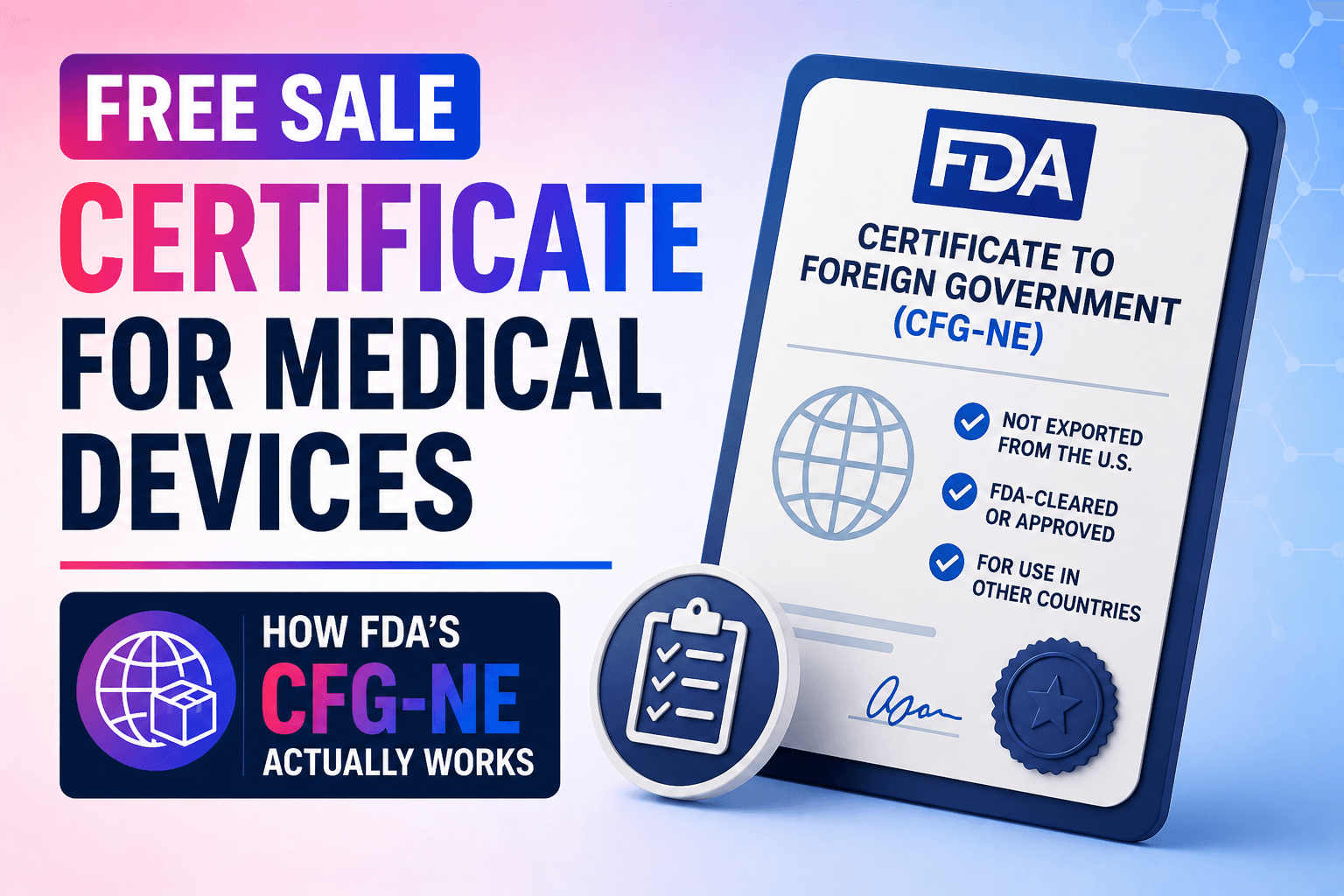
Quick answer: A Free Sale Certificate is an official document showing a product is legally marketable, registered, or authorized in the issuing regulator's home jurisdiction — many countries (Nigeria, and in some cases India, Vietnam, and others) require one from a recognized reference regulator before they'll register a foreign-made medical device for local sale. FDA's mechanism for producing this document is the Certificate to Foreign Government (CFG). Since December 2022, a specific version — the CFG-NE (Certificate to Foreign Government for Device Not Exported from the United States) — lets manufacturers whose devices are FDA-cleared or approved obtain this certificate for a shipment sent directly from one foreign country to another, without that specific shipment routing through the US [1, 2]. A completed US sale is not expressly required. However, the device must be legally authorized for US marketing AND must be imported or offered for import into the United States — establishment registration and device listing alone are not sufficient [2, 6]. The foreign manufacturing establishment must be currently FDA-registered, the device properly listed, applicable manufacturing facilities identified and in substantial cGMP compliance, and free of unresolved compliance or enforcement issues that would prevent issuance [2]. Requests go through CECATS. FDA charges $175 for the first certificate and $85 for each additional certificate from the same request, subject to a page-based calculation [2]. FDA's statute permits it to charge these fees when a request is processed within 20 working days — this is a fee condition, not a guaranteed issuance deadline [2, 5]. A CFG-NE may support medical device registrations in countries that accept FDA export certificates or US market-authorization evidence, but acceptance must be confirmed with each destination authority — it is not a universal replacement for a CE certificate or a country-of-origin Free Sale Certificate.
What a Free Sale Certificate Actually Is
When a manufacturer applies to register a medical device in a country where it has no existing regulatory track record, the local authority faces an obvious problem: how do they evaluate this product without running a full independent review from scratch?
Many national regulatory systems solve this by accepting evidence that a recognized "reference" regulator — one with established technical capacity, such as the US, EU, UK, Canada, Japan, or Australia — has already reviewed and authorized the product. A Free Sale Certificate (also called a Certificate of Free Sale, or a country-specific equivalent name) is the documentary proof of that: an official statement showing a product is legally marketable, registered, or authorized in the issuing authority's jurisdiction [7].
An important precision point: "legally marketable" is not the same claim as "actually sold." These certificates generally concern a device's legal marketing status, not proof that commercial transactions have occurred. FDA describes its own export certificates as documents containing information about a product's regulatory or marketing status in the United States [5] — status, not sales history.
Which countries actually require this, and how strictly, varies considerably. Rather than treat this as a uniform global requirement, it's worth being specific about what's actually documented:
Nigeria has clearly documented requirements here. NAFDAC's medical device registration guidance requires a Certificate of Manufacture and Free Sale, or a Free Sale Certificate, for imported devices, specifying it should come from an appropriate health or regulatory body [8].
India's CDSCO framework is more layered than a single blanket requirement. Import documentation distinguishes between a certificate or marketing authorization from the country of origin, and evidence from recognized jurisdictions including the US, UK, EU, Canada, Japan, or Australia. Where a device lacks approval from one of those reference authorities, CDSCO's more recent guidance describes alternative evidentiary paths, including safety and performance data combined with a certificate from the country of origin or another country where the device is marketed. A CFG-NE can be a useful piece of evidence within this framework — it is not necessarily the sole route [9].
Vietnam's device registration ecosystem clearly recognizes and issues Free Sale Certificates as part of its regulatory documentation practice, but the exact requirement can depend on device classification, application type, the specific decree in force, and current administrative procedure. Treat this as "may require or accept" rather than a blanket universal requirement.
Saudi Arabia and most of Latin America are cases where broad claims should be avoided without country-specific verification. Current Saudi SFDA materials focus principally on Saudi-issued marketing authorization and describe Saudi Free Sale Certificates as documents SFDA itself issues to Saudi-registered manufacturers — largely an export document from Saudi Arabia, not necessarily a documented requirement for a foreign manufacturer's CFG or CFG-NE. Latin American national systems (Brazil's ANVISA, Mexico's COFEPRIS, and others) differ materially from each other, and whether a Free Sale Certificate is required, optional, or substitutable depends heavily on the specific country and device class.
The practical takeaway: Free Sale Certificates or comparable market-authorization evidence are required or accepted across a meaningful number of foreign device registration systems, but the exact requirement varies by country, device class, and registration route. Confirm the specific requirement with each target country rather than assuming a uniform global rule.
The Credibility Question: What Actually Happens When a CE Certificate's Printed Date Passes
Many manufacturers — particularly across Southeast Asia, the Middle East, and South Asia — have relied on an EU CE Mark certificate to satisfy exactly this kind of third-country Free Sale Certificate requirement. This creates a real, but frequently misunderstood, risk connected to the EU's ongoing MDD-to-MDR transition.
The nuance that matters: A printed MDD certificate expiry date passing does not automatically mean the certificate is legally invalid. Under Regulation (EU) 2023/607, qualifying MDD/AIMDD certificates have their validity extended by operation of law, provided the manufacturer met the applicable transition conditions — an MDR-compliant quality management system and Notified Body application by May 26, 2024, and a signed Notified Body agreement by September 26, 2024. Where those conditions were met, the certificate remains legally valid through the applicable transition deadline (generally December 31, 2027 or December 31, 2028) even though the printed date on the physical document has passed. The European Commission has specifically published guidance for non-EU authorities addressing exactly this point, because it recognized third-country regulators might otherwise misread an expired printed date as an invalid certificate.
Where a manufacturer genuinely can lose usable EU marketability evidence: - The device or manufacturer didn't meet the transition conditions in the first place - The certificate was formally withdrawn - A significant design or intended-purpose change disqualified continued legacy status - The manufacturer missed an applicable MDR transition milestone - The relevant third-country authority simply refuses to recognize documentation demonstrating the certificate's legally extended validity, regardless of its EU-law status
Worth distinguishing precisely: a Notified Body certificate, a manufacturer's EU Declaration of Conformity, and a government-issued Certificate of Free Sale are three different documents. A CE certificate is not literally the same instrument as a Free Sale Certificate, even where it's been accepted as functionally equivalent evidence by a given third-country regulator.
For manufacturers navigating this specific transition mechanics — the exact conditions, deadlines, and Notified Body capacity situation — see Complizen's dedicated guide to the MDD-to-MDR transition.
FDA's Certificate to Foreign Government (CFG): The Historical Version and Its Gap
FDA has issued Certificates to Foreign Government for decades, confirming a device can be legally marketed in the United States in compliance with the FD&C Act [3]. The historical limitation: a standard CFG could only be issued for devices actually exported from the United States.
For a manufacturer whose device was FDA-authorized but manufactured entirely overseas, with no occasion for that device to ever pass through US commerce en route to a third country, there was no equivalent certificate available — even though the device was fully legal to sell in the US on paper.
The CFG-NE: What It Actually Requires
Section 3304 of the Consolidated Appropriations Act, 2023 — signed into law December 29, 2022 — amended Section 801(e)(4) of the FD&C Act to direct FDA to create a certification pathway addressing this specific gap [1, 2, 4]. The result is the CFG-NE.
What the CFG-NE covers: A CFG-NE may be issued for a foreign-manufactured device that is (1) authorized for US marketing, (2) imported or offered for import into the United States, and (3) shipped directly from one foreign country to another [2, 6]. All three conditions matter — not just the first.
The critical distinction to get right: the specific third-country shipment being certified does not need to pass through the United States. But the device itself — as a product line, separate from that particular shipment — must have a genuine, documented US import connection: it must be imported, or at minimum formally offered for import, into the United States. FDA's own CECATS application guidance states this as a hard requirement: "Each device must be imported or offered for import into the United States" [6]. Where a foreign manufacturer's device has no such import or offer-for-import connection, FDA generally lacks the jurisdictional basis to certify the device's conformity with the FD&C Act at all, regardless of how strong the manufacturer's US clearance or establishment registration otherwise looks.
What this means practically: A manufacturer cannot qualify for a CFG-NE purely on the strength of holding FDA clearance plus establishment registration and device listing. There needs to be an actual import event, or a documented offer for import, connecting the device to the United States — and CECATS application instructions require applicants to provide accurate import entry information as part of the request; missing or inaccurate entry details can delay or prevent issuance.
A corrected example: A Malaysian manufacturer holds FDA 510(k) clearance for a device and has imported, or formally offered for import, that device into the United States. Separately, the manufacturer also produces units in Malaysia intended for direct shipment to a distributor in Nigeria — a shipment that itself never passes through the US. Because the device and the manufacturing establishment fall within FDA's jurisdiction (via that documented US import connection), the manufacturer may request a CFG-NE covering the Malaysia-to-Nigeria shipment, provided all other conditions are satisfied. This is a materially different, and more accurate, picture than a manufacturer who has never had any import or offer-for-import connection to the US at all.
The Full Certification Requirements
FDA's requirements are documented on Form 3613g. Requesting establishments must certify [2, 6]:
- Each device on the certificate is manufactured by a device establishment located outside the United States
- Each establishment appearing on the certificate is currently registered under Section 510 of the FD&C Act
- Each establishment has listed each medical device appearing on the certificate, per Section 510(j) and 21 CFR Part 807
- Each device is authorized for US marketing under one of the accepted statuses
- Each device is imported or offered for import into the United States
- Each device is not the subject of an open import alert, seizure, injunction, or certain other enforcement matters that FDA's denial criteria identify as disqualifying (see the nuance on recalls below)
- Manufacturers, contract manufacturers, and contract sterilizers involved in the manufacturing process, where applicable, are identified
- The requesting establishment and all establishments involved in manufacturing are operating in substantial compliance with current Good Manufacturing Practice requirements under Section 520(f)
Accepted US marketing statuses. FDA's current CECATS application guidance recognizes a broader list than a simple "cleared or approved" summary suggests: 510(k) clearance, PMA approval, Humanitarian Device Exemption, De Novo classification, Product Development Protocol, Enforcement Discretion, Exempt status, and pre-amendment (grandfathered pre-May 28, 1976) devices all qualify as acceptable marketing statuses [6].
On enforcement actions — more nuanced than a blanket rule. The Form 3613g certification language broadly disqualifies devices subject to certain open enforcement matters. But FDA's own denial guidance treats this with more nuance than "any open recall disqualifies everything." The statutory denial grounds specifically include injunction proceedings, seizure actions, FDA-designated Class I or Class II recalls, and significant Quality System noncompliance. Critically, an open recall does not automatically eliminate an entire product line from eligibility — corrected products, or lots outside the specific scope of a lot-specific recall, may sometimes remain eligible if FDA's conditions are satisfied and the firm certifies that recalled lots will not be shipped under the certificate. Treat any open enforcement matter as a serious flag requiring case-specific evaluation, not an automatic, unconditional disqualifier for the entire device line.
How to Actually Request One
CFG-NE requests go through the CDRH Export Certification Application and Tracking System (CECATS), accessed via an establishment's existing FURLS account [2]. Within CECATS, responding "No" to "Will the devices be exported from the United States?" routes the application into the CFG-NE-specific pathway [2, 6].
Information needed: - FDA establishment registration number or owner/operator number - Product code and marketing status, with approval or clearance date, for each device - Accurate import entry information connecting the device to the US, where applicable - A complete device list for the certificate
Requestors sign a Shipper's Certification Statement affirming compliance with applicable FD&C Act requirements [2].
Costs, Timing, and Certificate Mechanics
Fees: $175 for the first certificate, $85 for each additional certificate generated from the same request [2]. Each electronic certificate is capped at 25 pages; fees depend on the total number of certificates requested and total page volume, since large device lists or multiple certificates can materially increase the total cost. Rely on the fee estimate CECATS itself generates for your specific request rather than a fixed rule of thumb. FDA invoices quarterly for certificates issued during that period [2].
On the 20-day figure — a fee condition, not a promised deadline. FDA's statutory authority permits it to charge the certificate fee specifically when a request is processed within 20 working days [2, 5]. This is not a guaranteed issuance deadline. Incomplete applications, requests returned for correction, import-entry questions, or compliance issues can extend processing well beyond that window. Budget for the fee, but don't treat 20 working days as a committed turnaround time.
Certificate format and validity: Since January 2, 2024, all certificates are issued electronically as downloadable PDFs through CECATS. You receive a one-time window of 45 days from issuance to print or download the document — after that window closes, the document is no longer accessible and a new application must be submitted [10]. Issued export certificates are generally valid for 2 years from the date of issuance [10].
Verification: Each certificate carries a unique QR code and certificate number. A foreign government, distributor, or their counsel can verify authenticity by scanning the QR code or entering the certificate number directly at FDA's FURLS Export Certificate Validator (FECV) — no account required [10].
Why This Matters Commercially
For manufacturers who've already invested in FDA clearance but aren't yet pursuing active US commercial distribution, the CFG-NE reframes what that FDA registration is actually worth. Rather than functioning purely as "step one toward the eventual US market," FDA establishment registration and device listing — combined with a documented US import or offer-for-import connection and a CFG-NE — can become the foundation for market-authorization evidence usable across a range of third countries that accept FDA export certificates.
This is a genuine strategic asset, but it's important to describe it accurately rather than as a guarantee. A CFG-NE may be rejected or discounted by a specific foreign authority for reasons entirely outside FDA's control — the destination country may require a certificate specifically from the country of manufacture, may demand proof of actual free sale in the country of origin, may recognize only a narrower list of specified reference authorities, may not recognize the CFG-NE certificate type specifically (as distinct from a standard CFG), may require legalization, apostille, or consular authentication of the document, or may require the certificate to cover exact models, trade names, or manufacturing sites in a way that needs careful matching.
The accurate framing: a CFG-NE may support a third-country registration where the destination authority accepts FDA export certificates or US market-authorization evidence as satisfying its Free Sale Certificate requirement. It is not an automatic universal substitute for a CE certificate or a country-of-origin Free Sale Certificate — acceptance should be confirmed with each destination regulator, not assumed.
Common Misconceptions
Misconception 1: "The Device Never Needs Any Connection to the United States"
Reality: The specific third-country shipment doesn't need to pass through the US. But the device itself must be imported, or formally offered for import, into the United States — this is a hard jurisdictional requirement, not a formality [2, 6]. FDA generally lacks the basis to issue a CFG-NE for a device with no US import connection at all.
Misconception 2: "Clearance Plus Registration and Listing Is Enough to Qualify"
Reality: Those are necessary but not sufficient. The device must also have a documented import or offer-for-import connection to the US, and the establishment and manufacturing chain must be free of disqualifying enforcement matters and in substantial GMP compliance [2, 6].
Misconception 3: "A Free Sale Certificate Proves the Product Has Actually Been Sold"
Reality: These certificates generally address legal marketability or authorized marketing status — not proof of completed commercial transactions [5, 7].
Misconception 4: "An Expired Printed Date on an MDD Certificate Means It's Invalid"
Reality: Where a manufacturer met the EU's 2023/607 transition conditions, the certificate remains legally valid through the applicable transition deadline by operation of law, regardless of the printed expiry date — though some third-country authorities may still require documentation demonstrating this extended validity, and may or may not accept it.
Misconception 5: "Any Open Recall Automatically Disqualifies the Entire Device Line"
Reality: FDA's evaluation is more fact-specific. Corrected products, or lots outside the scope of a lot-specific recall, may remain eligible if FDA's conditions are met and the firm certifies recalled lots won't be shipped under the certificate.
Misconception 6: "A CFG-NE Guarantees Acceptance by Any Third-Country Regulator"
Reality: Acceptance depends entirely on the destination country's own regulatory framework and its recognized list of reference-country documents. Confirm directly with the target regulator rather than assuming.
The Fastest Path to Market
No more guesswork. Move from research to a defendable FDA strategy, faster. Backed by FDA sources. Teams report 12 hours saved weekly.
Frequently Asked Questions
What is a Free Sale Certificate for a medical device?
A Free Sale Certificate is an official document from a recognized regulator confirming a product is legally marketable, registered, or authorized in that regulator's home jurisdiction. Many foreign medical device registration systems require or accept this kind of certificate from a reference regulator — such as the US, EU, UK, Canada, Japan, or Australia — as evidence supporting a local registration application, rather than requiring a full independent review from scratch [7].
Does my device need to have been sold in the United States to get a CFG-NE?
A completed US sale is not expressly required. However, the device must be legally authorized for US marketing and must be imported, or formally offered for import, into the United States — registration and listing alone are not sufficient to establish this connection [2, 6].
What is the difference between a standard CFG and a CFG-NE?
A standard Certificate to Foreign Government covers devices actually exported from the United States. A CFG-NE covers foreign-manufactured devices that are US-authorized, have a documented US import or offer-for-import connection, and are shipped directly from one foreign country to another without that specific shipment passing through the US [1, 2, 3].
What does "imported or offered for import into the United States" actually require?
This is a certifying condition on Form 3613g and a stated application requirement in CECATS [2, 6]. It requires a genuine, documented connection between the device and US import activity — not merely holding US marketing authorization. CECATS requires applicants to provide import entry information as part of a complete application; work through this specific requirement with a regulatory advisor to confirm how it applies to your device and manufacturing arrangement.
How much does a CFG-NE cost?
$175 for the first certificate, $85 for each additional certificate from the same request, calculated according to the total number of certificates and page volume (each certificate capped at 25 pages) [2]. Rely on the fee estimate CECATS generates for your specific application.
How long does it take to get a CFG-NE?
FDA's fee authority applies when a request is processed within 20 working days — this is a statutory fee condition, not a guaranteed processing deadline [2, 5]. Incomplete applications, correction requests, or import-entry questions can extend actual processing time.
What marketing statuses qualify a device for a CFG-NE?
510(k) clearance, PMA approval, Humanitarian Device Exemption, De Novo classification, Product Development Protocol, Enforcement Discretion, Exempt status, or pre-amendment (pre-May 28, 1976) grandfathered status all qualify under FDA's current CECATS guidance [6].
Does an open recall automatically disqualify a device from receiving a CFG-NE?
Not automatically for the entire product line. FDA's evaluation is fact-specific — corrected products or lots outside a lot-specific recall's scope may remain eligible if FDA's conditions are met and the firm certifies recalled lots won't be shipped under the certificate.
How do I verify a CFG-NE's authenticity?
Each certificate carries a unique QR code and certificate number. Scan the code or enter the certificate number at FDA's FURLS Export Certificate Validator (FECV) — no account required [10].
How long is a CFG-NE valid, and how long do I have to download it?
Certificates are generally valid for 2 years from issuance. You have a one-time 45-day window from issuance to print or download the document before it's no longer accessible [10].
Will a foreign regulator that previously accepted my CE Mark automatically accept a CFG-NE instead?
Not automatically. Acceptance depends on the destination country's specific regulatory framework, which may require a certificate from the country of manufacture, proof of actual free sale in the country of origin, a specific recognized reference-authority list, or particular authentication (legalization, apostille, consular) that a CFG-NE alone may not satisfy. Confirm directly with each destination authority.
Key Takeaways
1. The device needs a genuine US import connection — this is the single most important nuance. The third-country shipment itself doesn't need to pass through the US, but the device must be imported, or formally offered for import, into the United States. Clearance plus registration and listing alone do not satisfy this requirement [2, 6].
2. Free Sale Certificate requirements vary meaningfully by country — don't assume a uniform global rule. Nigeria's requirement is clearly documented; India's framework offers multiple evidentiary paths; Saudi Arabia and most Latin American countries need country-specific verification before assuming a foreign CFG-NE is required or even accepted.
3. An expired printed date on an MDD certificate doesn't automatically mean it's invalid. Where transition conditions were met, EU law extends validity through the applicable deadline regardless of the printed date — though third-country acceptance of that extended validity isn't guaranteed.
4. The full accepted marketing-status list is broader than "cleared or approved." 510(k), PMA, HDE, De Novo, PDP, Enforcement Discretion, Exempt, and pre-amendment status all qualify [6].
5. Treat commercial claims about the CFG-NE's value with appropriate caution. It may support third-country registrations where the destination authority accepts FDA export documentation — it does not guarantee or automatically replace CE Mark documentation, and acceptance should be confirmed country by country.
References
-
FDA: Transition to Electronic Export Documents — Letter to Industry (January 2, 2024)
https://www.fda.gov/medical-devices/industry-medical-devices/transition-electronic-export-documents-letter-industry -
FDA: Devices Not Exported from the United States
https://www.fda.gov/medical-devices/exporting-medical-devices/devices-not-exported-united-states -
FDA: Types of Export Certificates
https://www.fda.gov/medical-devices/exporting-medical-devices/types-export-certificates -
Section 3304, Consolidated Appropriations Act, 2023
https://www.govinfo.gov/content/pkg/BILLS-117hr2617enr/pdf/BILLS-117hr2617enr.pdf -
FDA: Exporting Medical Devices — Frequently Asked Questions (FAQs)
https://www.fda.gov/medical-devices/exporting-medical-devices/exporting-medical-devices-frequently-asked-questions-faqs -
FDA: Certificate to Foreign Government for Device Not Exported from the United States (CFG-NE) Application Guide, CECATS
https://www.access.fda.gov/cecats/help/cecats-cfgne-guide.html -
FDA: Exporting Medical Devices
https://www.fda.gov/medical-devices/importing-and-exporting-medical-devices/exporting-medical-devices -
NAFDAC: Guidelines for Registration of Medical Devices (Imported and Locally Manufactured) in Nigeria
https://nafdac.gov.ng/wp-content/uploads/Files/Resources/Guidelines/DR_And_R_Guidelines/Guidelines-for-Registration-of-Medical-Devices-in-Nigeria.pdf -
CDSCO: Medical Device Rules, 2017 — Fourth Schedule requirements and reference-market Free Sale Certificate provisions
https://cdsco.gov.in/opencms/opencms/en/Medical-Device-Diagnostics/ -
FDA: Print and Validate a CDRH-Issued Export Certificate/Letter
https://www.access.fda.gov/cecats/help/print_e_certificate_approval_letter_and_validate_cert.html -
21 CFR Part 807 — Establishment Registration and Device Listing
https://www.ecfr.gov/current/title-21/chapter-I/subchapter-H/part-807 -
Regulation (EU) 2023/607 of the European Parliament and of the Council of 15 March 2023 — Official Text
https://eur-lex.europa.eu/eli/reg/2023/607/oj/eng