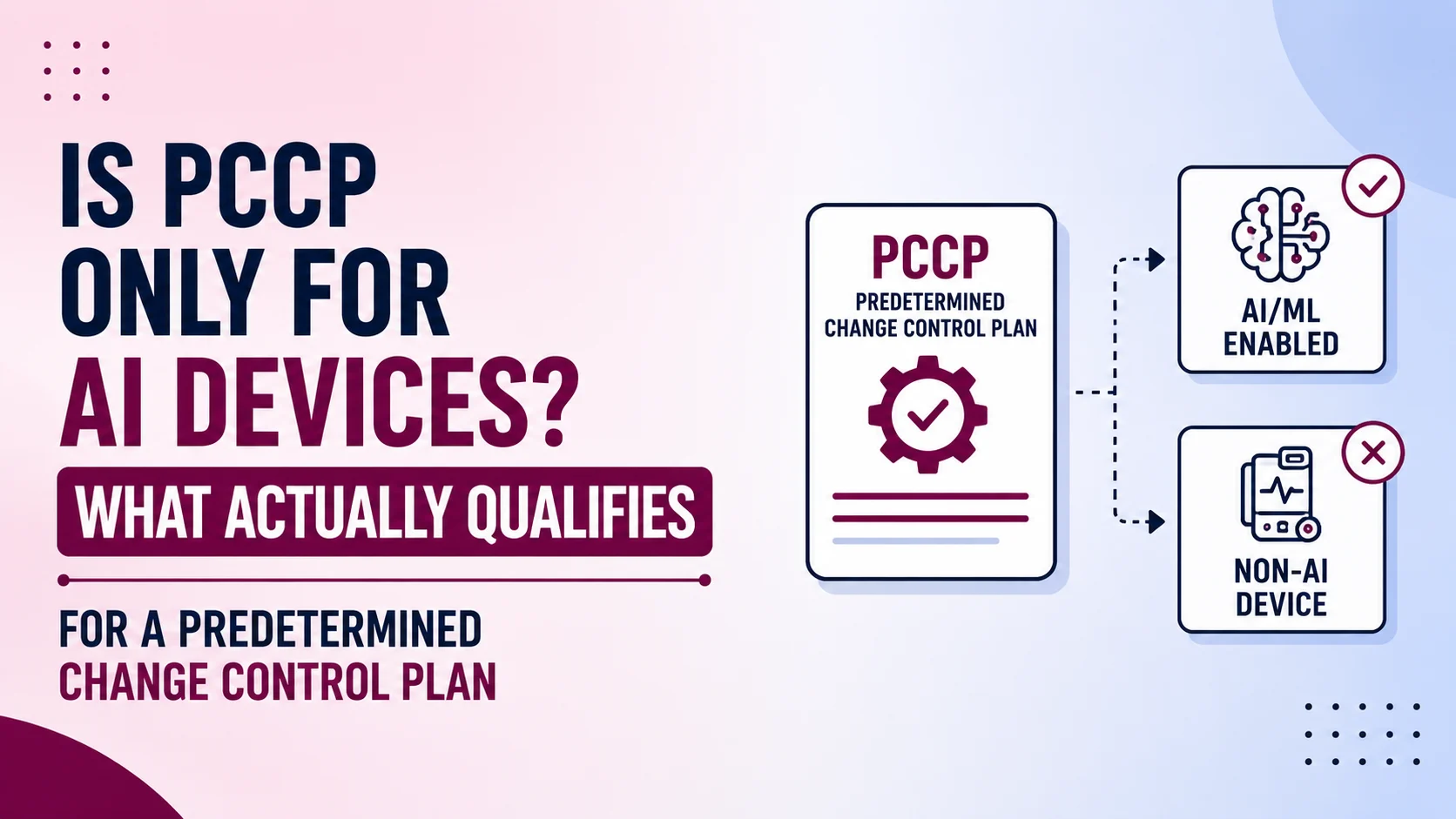
Quick Answer: A Predetermined Change Control Plan (PCCP) is not legally limited to AI or machine learning devices. The mechanism comes from Section 515C of the FD&C Act, added by FDORA in December 2022, and it applies to any device modification that can be specified in advance and validated against a defined protocol. A PCCP lets a manufacturer pre-describe future changes inside its original marketing submission, so those specific changes don't require a new 510(k), PMA supplement, or De Novo request once implemented. The AI-only impression comes from a gap in FDA's own guidance: the only finalized PCCP document, issued December 2024, is written specifically for AI-enabled device software functions. A broader guidance covering all device types has existed only in draft form since August 2024. FDA's own notice calls it "not final nor is it for implementation at this time," though finalizing it is now on FDA's list of guidance priorities for fiscal year 2026.
Two guidances, two different levels of settled policy
This is the fact that explains almost everything else about how PCCP actually works today, and it's worth being precise about it.
FDA has published two separate PCCP guidance documents. "Marketing Submission Recommendations for a Predetermined Change Control Plan for Artificial Intelligence-Enabled Device Software Functions" became final on 4 December 2024, following a 2023 draft. It applies specifically to devices with AI-enabled device software functions, across the 510(k), De Novo, and PMA pathways.
"Predetermined Change Control Plans for Medical Devices" — the general, cross-device-type guidance — was issued as a draft on 22 August 2024. As of this writing, it remains a draft. Every page carries the header "Contains Nonbinding Recommendations, Draft – Not for Implementation," and FDA's own Federal Register notice for it states plainly: "This draft guidance is not final nor is it for implementation at this time." FDA has since named finalizing it a current priority — it appears on CDRH's published list of final guidance topics targeted for fiscal year 2026 — but as of today it has not been finalized.
That gap matters in a specific way. The statute itself, Section 515C, doesn't distinguish between AI and non-AI devices — it authorizes PCCPs for any device requiring premarket approval or premarket notification. A manufacturer with a suture, an in vitro diagnostic, or an implantable pulse generator has exactly the same legal basis to propose a PCCP as a manufacturer of AI-enabled software. What that manufacturer doesn't have is a finalized FDA document written for their situation. The general draft guidance is the best available signal of FDA's thinking, and it's detailed and useful — but it is, by FDA's own label, not binding, and manufacturers should expect more interactive back-and-forth precisely because less has been settled in writing for non-AI device types.
If your device does include an AI-enabled software function, the finalized guidance is the one to work from, and our PCCP implementation guide for AI/ML-enabled devices covers that in detail. This piece is for everyone else.
What a PCCP actually is
A PCCP is not permission to change a device however you like. It's permission to make specific, pre-described changes, validated in a specific, pre-described way, reviewed and authorized as part of your original marketing submission rather than after the fact.
Every PCCP, regardless of device type, must contain three components:
Description of Modifications — a detailed list of the specific, planned changes, described precisely enough that FDA can understand exactly what will change about the device's characteristics and performance.
Modification Protocol — the methodology for developing, validating, and implementing each modification, including pre-defined acceptance criteria. This is where you specify how you'll prove the change is safe before you make it.
Impact Assessment — an analysis of the benefits and risks of each modification, individually and cumulatively, and how the Modification Protocol's verification activities continue to support the device's safety and effectiveness.
FDA reviews all three as part of your original submission. Once authorized, changes that fall inside the plan's bounds and follow its protocol don't need a new submission. Changes that fall outside — even slightly outside — do. There's no gray zone by design; the bounds are the bounds.
FDA's own examples, none of them software
The draft general guidance includes eight illustrative examples, and what's notable is that none of them are AI or machine learning devices. They're the clearest evidence available that FDA always intended PCCP to apply broadly. A few, direct from the guidance:
A cancer-predisposition IVD (a saliva-based genetic test for BRCA1/BRCA2 variants): adding new single nucleotide variants, or updating labeling for cross-reactive polymorphisms, may be appropriate for a PCCP. Adding a new gene entirely, or changing the sample type from saliva to a buccal swab, is not.
A potassium ion-selective electrode for a lab chemistry analyzer: adding a new electrode of the same type may be appropriate. Adding a new sample type like urine, or enabling point-of-care use, is not.
A non-absorbable surgical suture: switching to a different, well-established sterilization method, or extending shelf life using an established method, may be appropriate. Adding antimicrobials, or a stiffening agent to address a recall, is not.
A multi-parameter patient monitor: adding compatibility with a newly cleared monitoring module, or improving an existing algorithm's display, may be appropriate. Adding an entirely new physiological parameter, or a novel predictive algorithm, is not.
An antimicrobial susceptibility test: planned updates to breakpoints consistent with FDA's recognized interpretive criteria database may be appropriate — this specific use case already had its own final guidance in 2023, predating the general PCCP framework. Adding a new drug or organism species to test is not.
The pattern across every example is consistent: modifications that stay within the device's existing intended use and are validated by well-characterized, established methods tend to qualify. Modifications that touch intended use, introduce genuinely new risk, or would need new clinical data tend not to.
The decision logic, in plain terms
For 510(k) and De Novo devices, FDA's own recommended process runs through a short sequence of questions. Could the modification be a major change to intended use? If yes, it's generally not appropriate for a PCCP — full stop, regardless of anything else. If no: could it significantly affect safety or effectiveness? If no, it likely doesn't need PCCP treatment at all — it's a routine change your quality system already handles. If yes: could it introduce a genuinely new risk that didn't exist for the original device? If yes, it's generally not appropriate. If it would instead significantly modify an existing risk — one your current risk management framework already addresses — it may be appropriate, provided that framework adequately mitigates it.
For PMA devices, the framework is similar but keyed to whether the change qualifies as a "minor change" (the kind normally handled through a real-time supplement) or a "manufacturing change" (normally a 30-day notice). Changes of that character generally may be appropriate for a PCCP; changes that would otherwise need full PMA supplement review generally are not.
The predicate consequence almost nobody plans for
Section 515C(c) of the FD&C Act contains a specific rule worth understanding before you rely on a PCCP strategically: only the version of a device cleared or approved before changes made under a PCCP may be used as a predicate device by anyone, including you. If you use your authorized PCCP to evolve your device through several modifications, competitors comparing against your product line can only cite your original, pre-PCCP version — not the improved one you're currently shipping.
This cuts both ways. If you're relying on a competitor's device as your own predicate, confirm which version you're actually entitled to cite — their marketed device today may not be the version available to you as a predicate if it has since evolved under an authorized PCCP.
Your quality system is not optional infrastructure here
A PCCP doesn't operate independently of your quality management system — it depends on it. Modifications implemented under an authorized PCCP must be documented and controlled consistent with your quality system, and FDA has explicit authority to withhold a PCCP's authorization based on QSR compliance history: it must deny PMA approval where manufacturing controls don't conform to the QSR, and may withhold 510(k) clearance where noncompliance presents a substantial likelihood of serious risk.
With the Quality Management System Regulation now incorporating ISO 13485:2016 by reference as of 2 February 2026, this is also where PCCP strategy and your broader quality system planning converge — a PCCP is only as credible as the quality infrastructure that will actually implement and document each modification when the time comes. Working out which of your existing quality processes already support a defensible Modification Protocol, versus which need building specifically for the plan, is exactly the kind of gap analysis worth doing before a PCCP goes into a submission rather than after FDA asks about it.
What this means practically if you're not building AI
Engage FDA's Q-Submission Program before you file. FDA explicitly recommends this, and it matters more here than it would for an AI device working from finalized guidance — there's simply less written precedent for FDA staff and for you to align on. Early feedback on whether your proposed scope is appropriate is worth more than usual.
Keep the plan narrow. FDA's own guidance is explicit that a PCCP should include only a few, specific, verifiable modifications — not a broad menu of everything you might someday want to change. A sprawling PCCP is harder for FDA to authorize and harder for you to actually validate against.
Treat the draft guidance as a strong signal, not a rulebook. It reflects FDA's current thinking in detail, including the examples above, but it isn't binding, and specifics may shift when it's finalized. Build your plan around the underlying statute and the guiding principles, using the draft's examples as calibration rather than as a checklist to follow mechanically.
Don't assume a modification is routine just because it seems minor. The distinction FDA actually draws is between changes that introduce a new risk (generally not appropriate) and changes that modify an existing, already-mitigated risk (may be appropriate) — a distinction that depends on your risk management file, not on how significant the change feels.
Common mistakes
Assuming PCCP is an AI-specific mechanism. It's a general statutory authority; AI simply has the only finalized implementing guidance so far.
Treating the August 2024 draft general guidance as settled policy. It remains a draft more than two years after publication. Build in room for FDA's specifics to shift.
Conflating "introduces a new risk" with "modifies an existing risk." FDA treats these very differently — the first is generally disqualifying, the second may be workable if your existing risk framework already covers it.
Assuming a competitor's currently marketed device is available to you as a predicate. If it evolved under an authorized PCCP, only the original, pre-PCCP version is eligible.
Building a PCCP without quality system readiness to match. FDA can deny or withhold authorization based on QSR/QMSR compliance history independent of the PCCP's own content.
Frequently asked questions
Is a Predetermined Change Control Plan only for AI devices? No. PCCP authority comes from Section 515C of the FD&C Act, which applies to any device requiring premarket approval or premarket notification, not just AI-enabled ones. FDA's only finalized PCCP guidance happens to be AI-specific (December 2024), which creates the impression that the mechanism itself is AI-only. A separate draft guidance covering all device types has existed since August 2024 but hasn't been finalized.
What is a Predetermined Change Control Plan? A section of a device's marketing submission that pre-specifies future modifications, the methodology to validate them, and an assessment of their impact — reviewed and authorized alongside the original submission so that implementing those specific, pre-described changes later doesn't require a new 510(k), PMA supplement, or De Novo request.
Is FDA's general PCCP guidance final? No. "Predetermined Change Control Plans for Medical Devices," covering all device types, was issued as a draft on 22 August 2024 and remains a draft — FDA's own Federal Register notice states it is "not final nor is it for implementation at this time." Only the AI/ML-specific PCCP guidance, finalized 4 December 2024, currently carries FDA's finalized recommendations. FDA has listed finalizing the general guidance among its priority guidance topics for fiscal year 2026.
What are the three required components of a PCCP? A Description of Modifications (the specific planned changes), a Modification Protocol (how each change will be developed, validated, and implemented, with pre-defined acceptance criteria), and an Impact Assessment (the benefits, risks, and cumulative effect of the modifications). All three are required regardless of device type.
Can a physical device like a suture or an IVD use a PCCP? Yes. FDA's draft general guidance includes specific illustrative examples for a surgical suture, an in vitro diagnostic, a potassium ion-selective electrode, a patient monitor, and other non-software device types, describing exactly what kinds of modifications may or may not be appropriate for each.
What kinds of modifications are not appropriate for a PCCP? Generally: changes to the device's intended use, changes to the control mechanism, operating principle, or energy type, changes from single-use to reusable, changes that would need new clinical data, and changes made to address a recall or safety issue. FDA also excludes modifications that would introduce a genuinely new risk not present in the original device.
Can a device modified under a PCCP still be used as a predicate device? Only its pre-PCCP version. Under Section 515C(c) of the FD&C Act, a sponsor may cite only the version of a device cleared or approved before PCCP-authorized changes were made — not the current, evolved version — as a predicate for a new 510(k).
Which submission types can include a PCCP? For PMA devices: original PMA applications, modular PMAs, 135-day supplements (manufacturing changes only), panel-track supplements, and real-time supplements for minor changes. For 510(k) devices: traditional and abbreviated 510(k) submissions. For De Novo: the original request only.
Should I request a Q-Submission meeting before including a PCCP? FDA explicitly encourages it, and it's particularly valuable for non-AI devices, where less FDA policy has been finalized in writing. A Q-Submission meeting lets you get direct feedback on whether your proposed scope is appropriate before committing it to a marketing submission.
Does a PCCP remove the need for a strong quality system? No — it depends on one. FDA can deny PMA approval or withhold 510(k) clearance based on quality system compliance history independent of the PCCP's technical content, and every modification implemented under an authorized PCCP must be documented consistent with the manufacturer's quality system.
Key takeaways
PCCP is a statutory mechanism, not an AI feature. Section 515C applies to any device type; AI simply has the only finalized guidance so far.
The general guidance is still a draft, but finalizing it is now an active FDA priority. More than two years after publication, FDA's own Federal Register notice says it is "not final nor is it for implementation" — but it's also on FDA's list of guidance topics targeted for finalization in fiscal year 2026. Treat it as strong current thinking, not settled policy, until then.
FDA's own examples are the best available calibration tool. Eight illustrative, non-software examples in the draft guidance show concretely what tends to qualify and what doesn't.
The predicate rule is easy to miss and worth planning around. Only a device's pre-PCCP version is eligible to serve as anyone's predicate, including your own competitors'.
A PCCP is only as strong as the quality system behind it. FDA's authority to withhold authorization based on QSR/QMSR compliance operates independently of the plan's technical merits.
Complizen helps international medical device manufacturers reach FDA 510(k) clearance, combining a software platform for in-house regulatory teams with full-service consultancy for teams without in-house FDA expertise.
Scoping a PCCP against FDA's actual guidance and your own risk management file — rather than guessing at what might qualify — is worth doing before it goes into a submission. Complizen's regulatory strategy engagement maps your device to a pathway and reviews submission strategy with a senior FDA expert. See how the strategy service works →
References
- FDA — Predetermined Change Control Plans for Medical Devices (draft guidance, issued 22 August 2024). https://www.fda.gov/media/180978/download
- Federal Register — Predetermined Change Control Plans for Medical Devices; Draft Guidance for Industry and Food and Drug Administration Staff; Availability (notice of draft guidance, 22 August 2024). https://www.federalregister.gov/documents/2024/08/22/2024-18828/predetermined-change-control-plans-for-medical-devices-draft-guidance-for-industry-and-food-and-drug
- FDA (CDRH) — Proposed Guidances for Fiscal Year 2026 (lists "Predetermined Change Control Plans for Medical Devices" as an A-List final guidance priority). https://www.fda.gov/media/188993/download
- FDA — Marketing Submission Recommendations for a Predetermined Change Control Plan for Artificial Intelligence-Enabled Device Software Functions (final guidance page). https://www.fda.gov/regulatory-information/search-fda-guidance-documents/marketing-submission-recommendations-predetermined-change-control-plan-artificial-intelligence
- Federal Register — Marketing Submission Recommendations for a Predetermined Change Control Plan for Artificial Intelligence-Enabled Device Software Functions; Guidance for Industry (notice of final guidance availability, 4 December 2024). https://www.federalregister.gov/documents/2024/12/04/2024-28361/marketing-submission-recommendations-for-a-predetermined-change-control-plan-for-artificial
- Congress.gov — Consolidated Appropriations Act, 2023, Pub. L. No. 117-328, Division FF, Title III (Food and Drug Omnibus Reform Act of 2022), Section 3308. https://www.congress.gov/117/plaws/publ328/PLAW-117publ328.pdf
- FDA — Quality Management System Regulation (QMSR). https://www.fda.gov/medical-devices/postmarket-requirements-devices/quality-management-system-regulation-qmsr
- King & Spalding — FDA Publishes Final Predetermined Change Control Plan Guidance for AI-Enabled Device Software Functions (secondary source; legal analysis). https://www.kslaw.com/news-and-insights/fda-publishes-final-predetermined-change-control-plan-guidance-for-ai-enabled-device-software-functions