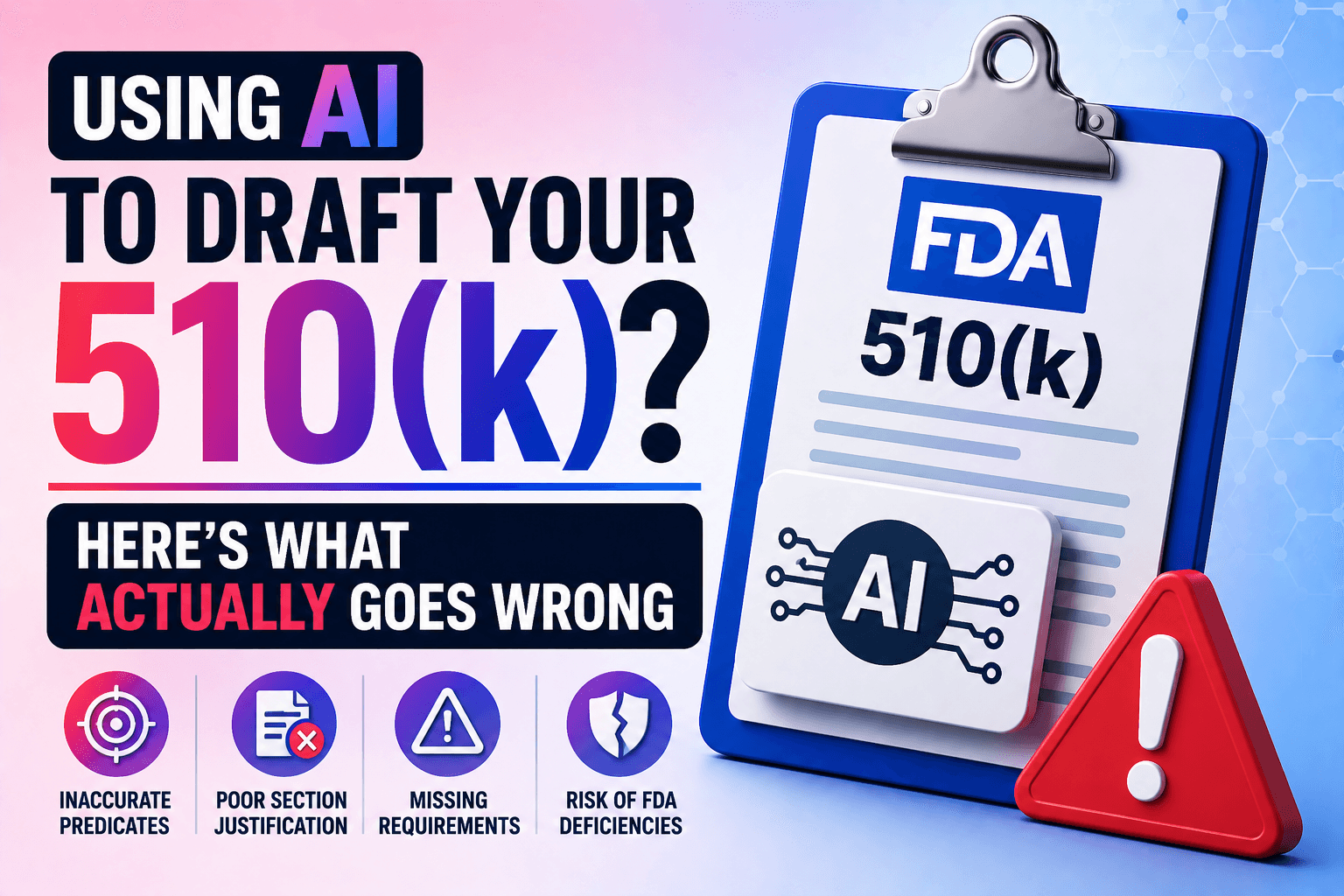
Using AI to Draft Your 510(k)? Here's What Actually Goes Wrong
Quick answer: Generative AI can help draft sections of a 510(k) submission—organizing content, summarizing literature, drafting boilerplate device description language—but using it without independent verification creates specific, well-documented failure modes: fabricated citations, mischaracterized predicate comparisons, and confidently-stated technical claims that aren't supported by your actual data. A 2025 study found AI-generated medical text contained factual hallucinations in roughly 1.5% of clinician-reviewed sentences [1]—a rate that sounds small until you consider a typical 510(k) submission runs hundreds of pages with thousands of individual factual claims. FDA reviewers cross-reference submissions against underlying data and cited sources; one fabricated or mischaracterized claim discovered during review raises scrutiny on the entire submission, not just the flagged section. The fix isn't avoiding AI—it's knowing exactly which parts of a 510(k) are safe to draft with AI assistance and which parts require independent, source-verified human review before submission.
Why This Question Matters More for 510(k)s Than Most Documents
A 510(k) submission isn't like an internal memo or a marketing email. It's a legal document submitted to a federal regulatory agency, reviewed by a trained scientific reviewer whose job is specifically to check whether your claims are supported by your data. That combination—high factual density, expert scrutiny, and legal consequence—makes AI-assisted drafting both more useful and more dangerous than in almost any other business context.
Where AI genuinely helps:
- Organizing submission structure per FDA's eSTAR template
- Drafting boilerplate sections (administrative information, general device description scaffolding)
- Summarizing your own internal test reports into submission-ready language
- Identifying gaps in your submission draft against FDA's checklist requirements
- Drafting first-pass language you'll heavily edit and verify
Where AI creates real risk:
- Generating literature citations or summarizing external research
- Characterizing predicate device comparisons
- Making substantial equivalence arguments
- Describing test results or data you haven't explicitly provided to it
- Drafting risk analysis or clinical justification language
The dividing line: AI is safe for structure and language polish on content YOU supply. AI is dangerous when asked to supply facts, citations, or technical characterizations on its own.
The Hallucination Problem, Quantified
"AI makes things up sometimes" is not a useful risk statement for a regulatory team. Here's what the actual data shows.
How Often Does This Happen?
A 2025 clinical study evaluating AI-generated medical text found a hallucination rate of approximately 1.47% across nearly 13,000 clinician-annotated sentences [1]—meaning roughly 1 in every 68 factual sentences contained a fabricated or incorrect claim that a trained clinician had to catch. Researchers have also found that inference-time mitigation techniques reduce but do not eliminate hallucination rates across every model architecture tested [1].
Why 1.47% sounds small but isn't:
A typical 510(k) submission—device description, substantial equivalence comparison, performance testing summary, labeling, risk analysis—easily contains several thousand individual factual assertions once you count every technical specification, every comparison point, every citation, and every characterization of test data. At a 1.47% error rate with zero independent verification, a 3,000-statement submission could contain 40+ factual errors, any one of which could be the detail an FDA reviewer catches and questions.
Where Hallucinations Specifically Show Up in Regulatory Content
Fabricated or misattributed citations: This is the most well-documented failure mode [7, 8]. AI models generate citations that look completely legitimate—plausible author names, plausible journal titles, plausible publication years—that simply don't exist, or that exist but don't say what the AI claims they say.
Mischaracterized test data: When asked to summarize test results, AI can generate language that overstates certainty, drops important caveats, or describes a test as demonstrating something the raw data doesn't actually support.
Invented technical specifications: If AI is asked to compare your device to a predicate and it doesn't have complete data on the predicate, it can generate plausible-sounding specifications that aren't accurate—filling gaps with statistically likely values rather than flagging the gap.
Overstated substantial equivalence claims: AI models are optimized to produce confident, fluent, persuasive text. This works against you specifically in substantial equivalence arguments, where FDA wants precise, defensible, appropriately hedged claims—not maximally persuasive ones.
This Isn't Theoretical: Parallel Cases from Adjacent Regulated Fields
Medical device submissions aren't the only regulated documents where this has already caused real problems. The pattern is consistent enough across fields that it's worth understanding as a general phenomenon, not a hypothetical.
Legal Filings: The Canary in the Coal Mine
Courts have documented well over a thousand incidents of AI-generated legal filings containing fabricated case citations across multiple jurisdictions [as tracked in ongoing legal industry databases]. In one 2025 Canadian federal court case, the court addressed a submission containing fabricated or misrepresented case law generated through AI-assisted research, and in the related costs decision, personally sanctioned the attorney involved [2]—establishing that "the AI did it" is not a defense against a fabrication finding.
Notably, this problem isn't confined to inexperienced users. In one widely reported 2025 incident, even a major law firm using a leading AI model for citation formatting had errors introduced into citations that were subsequently caught in court. If sophisticated legal teams using enterprise AI tools for a narrow, low-risk task (formatting existing citations, not generating new ones) can have errors slip through, the risk is not eliminated by expertise alone—it requires an explicit verification step.
The Regulatory Response Pattern
Legal and compliance analysts tracking this trend across regulated industries have observed a consistent pattern: when AI-generated content enters a regulated submission, filing, or safety assessment without adequate verification, oversight bodies do not treat it as a "software glitch" [2]. They treat it as a failure of the human review process, governance, and data integrity controls surrounding the tool—not a novel category of excuse.
Why this matters for 510(k) submitters specifically: FDA has no formal policy stating "AI-assisted content gets special scrutiny." But the underlying accountability structure is the same as in every other regulated field: you are responsible for the accuracy of everything you submit, regardless of what tool helped draft it. A fabricated citation in your literature review is treated exactly like a fabricated citation your intern typed manually—as a data integrity problem attributable to your quality system, not to the drafting tool.
Real Scenario: What This Looks Like in a 510(k) Review
Scenario: Manufacturer uses generative AI to draft the literature review portion of a substantial equivalence argument
Setup: A device manufacturer is preparing a 510(k) for a moderate-risk Class II device. The regulatory affairs lead uses a generative AI tool to help draft a section summarizing published literature supporting the safety profile of the device category, intending to strengthen the substantial equivalence narrative.
What happens without verification:
- AI tool generates a well-organized paragraph citing four studies supporting the device category's safety profile
- Regulatory affairs lead reviews the paragraph for tone and clarity, not source accuracy—the citations look properly formatted and the studies sound plausible
- Content is incorporated into the 510(k) submission largely as drafted
- FDA reviewer, following standard practice, attempts to locate one of the cited studies to verify a specific safety claim
- The study either doesn't exist, or exists but doesn't support the specific claim attributed to it
- FDA issues an Additional Information request, not just asking about that citation, but requesting verification of ALL data sources cited throughout the submission
- Timeline impact: what should have been a straightforward AI response cycle becomes a full-submission data integrity review, potentially adding months
- Reputational impact: the specific reviewer assigned to your submission now scrutinizes every subsequent claim more closely—the "benefit of the doubt" that speeds up routine reviews is gone
What should happen instead:
- AI tool is used to draft the STRUCTURE of the literature review (organization, transitions, how to frame the argument)
- Every citation is independently verified against the primary source before inclusion—confirming the study exists, confirming it says what's claimed, confirming the citation format is accurate
- Regulatory affairs lead documents this verification (even informally, for internal record)
- Content submitted to FDA is fully accurate because verification happened before submission, not after a finding
The lesson: The actual risk was never "using AI to draft." The risk was skipping verification because the output looked polished and complete. Fluent, confident-sounding AI text is specifically dangerous because it removes the visual cues (awkward phrasing, obvious gaps, uncertain hedging) that would normally prompt a human reviewer to double-check.
Where AI-Drafted Content Specifically Puts Your Substantial Equivalence Argument at Risk
Substantial equivalence is the legal and scientific backbone of a 510(k). It requires precise, defensible characterization of your device against a predicate—not persuasive writing.
The Persuasion vs. Precision Problem
Generative AI models are trained, broadly, to produce text that reads as helpful, confident, and complete. This is exactly the wrong optimization target for a substantial equivalence argument, which requires:
- Precise hedging where data is limited ("testing demonstrated X under conditions Y" rather than "testing conclusively demonstrated X")
- Accurate characterization of differences from the predicate, not minimization of them
- Claims that are defensible against a skeptical, trained reviewer—not claims optimized to sound persuasive to a general reader
Example of the failure mode:
If you ask an AI tool to "help make the case that our device is substantially equivalent to [predicate]," you're implicitly asking it to be persuasive. The result can be language that overstates similarity, glosses over technological differences that actually matter, or characterizes your testing as more conclusive than it was. This isn't malicious—it's the AI doing exactly what a "make a persuasive case" prompt asks for. But FDA reviewers are specifically trained to look for exactly this kind of overreach, and it undermines credibility the moment it's caught.
Where This Compounds: Predicate Data You Didn't Explicitly Provide
If you ask an AI tool to compare your device against a predicate device and don't supply complete, verified predicate specifications, the AI may fill gaps with plausible-sounding but unverified information about the predicate—drawn from its general training data rather than the actual predicate's cleared 510(k) summary.
This is a specific and correctable risk: Always supply the AI tool with the actual predicate 510(k) summary, clearance letter, and product code documentation rather than asking it to "recall" or "look up" predicate specifications from general knowledge. Ground every predicate comparison in source documents you've verified yourself.
What FDA Reviewers Actually Do That Catches This
Understanding the review process clarifies exactly why unverified AI content is so risky in this specific context.
FDA's Standard Verification Practices
Citation checking: For safety and effectiveness claims supported by literature citations, reviewers routinely verify that cited sources exist and support the specific claim attributed to them, particularly for claims central to the substantial equivalence argument.
Predicate cross-referencing: Reviewers have direct access to the actual cleared 510(k) summaries for any predicate device you cite. Any characterization of a predicate that doesn't match its actual clearance documentation is immediately visible to the reviewer, since they're comparing your submission directly against source records they control.
Internal consistency checking: Reviewers check whether claims in one section of your submission (e.g., device description) are consistent with claims in another section (e.g., testing summary, labeling). AI-drafted sections written somewhat independently of each other can introduce inconsistencies that a single human author working from one mental model would be less likely to create.
Data traceability: For any performance claim, reviewers expect it to trace back to an actual test report in your submission. AI-generated summary language that slightly overstates or mischaracterizes what a test report actually showed creates a traceability gap the moment a reviewer checks the underlying report.
What Happens When a Reviewer Catches One Error
The practical consequence of catching a single hallucinated or mischaracterized claim is rarely limited to that claim alone. Once a reviewer identifies one inaccuracy, standard practice shifts toward heightened scrutiny of the entire submission—because the discovery reasonably raises the question of what else might be inaccurate. This is the mechanism by which one small, avoidable error (a fabricated citation, an overstated test result) can cascade into a much larger Additional Information request covering data the reviewer would otherwise have accepted without extensive verification.
Practical Framework: How to Use AI for 510(k) Drafting Safely
Tier 1: Safe for AI Drafting Without Extensive Verification
- Administrative sections (cover letter structure, table of contents, submission organization per eSTAR template)
- Formatting and organizing content you've already verified
- Drafting boilerplate language for standard sections (general device description framing, standard labeling disclaimers)
- Summarizing YOUR OWN test reports that you provide directly to the AI tool (with verification that the summary accurately reflects the source)
Tier 2: Requires Independent Verification Before Submission
- Any literature review or citation of external published research
- Any comparison to predicate devices (must be grounded in actual predicate 510(k) documentation you supply)
- Summaries of test data, even your own, that make claims about statistical significance, performance thresholds, or comparative superiority
- Risk analysis narrative language
Tier 3: Should Not Be AI-Generated Without Full Expert Authorship
- Substantial equivalence legal/scientific argument core logic
- Novel technological characteristic justifications
- Responses to FDA Additional Information requests (these require precise, case-specific technical and regulatory judgment)
- Clinical significance interpretations
The Verification Protocol
For any Tier 2 or Tier 3 content that involved AI assistance:
- Source-check every citation — confirm the source exists, confirm it says what's claimed, confirm the citation format is accurate
- Cross-reference every predicate claim against the actual cleared 510(k) summary, not AI-recalled information
- Have a subject matter expert review every data characterization against the underlying test report
- Check internal consistency across sections — does the device description match the testing summary match the labeling?
- Document the verification — even an informal internal record of who checked what strengthens your quality system position if ever questioned
Common Mistakes Manufacturers Make
Mistake 1: Treating AI Output as a Finished Draft Rather Than a First Pass
Reality: Fluent AI-generated text creates a false sense of completeness. The polish of the writing has zero correlation with the accuracy of the underlying claims. Treat every AI-generated factual claim as unverified until checked, regardless of how confident or well-written it sounds.
Mistake 2: Asking AI to "Find" Supporting Literature Rather Than Supplying It
Reality: When you ask a general-purpose AI tool to identify literature supporting a claim, you're asking it to generate citations from its training data, which is exactly where fabrication risk is highest. Instead, conduct your own literature search (or have a regulatory consultant do it), then use AI only to help summarize or organize the sources YOU'VE already verified.
Mistake 3: Letting AI Draft Predicate Comparisons from Memory
Reality: AI models may have general knowledge about device categories but rarely have complete, accurate specifications for a specific predicate's actual cleared 510(k). Always supply the actual predicate summary document and instruct the tool to work only from that source.
Mistake 4: Assuming a More Sophisticated AI Model Eliminates the Risk
Reality: Hallucination is a known characteristic of the current generation of generative AI models broadly, not a flaw specific to weaker models. Even sophisticated users at experienced organizations using advanced models have had citation errors slip through review. Verification discipline matters more than model selection.
Mistake 5: Not Distinguishing Between Grounded and Ungrounded AI Use
Reality: There's a meaningful difference between AI generating content from open-ended general knowledge (higher hallucination risk) versus AI working strictly from source documents you've explicitly supplied in the same conversation (substantially lower risk, though still not zero). Structure your AI-assisted workflow to maximize the second category and minimize the first.
The Fastest Path to Market
No more guesswork. Move from research to a defendable FDA strategy, faster. Backed by FDA sources. Teams report 12 hours saved weekly.
Frequently Asked Questions
Can I use AI to draft any part of my 510(k) submission?
Yes, for lower-risk sections like administrative content, formatting, and organizing content you've already verified. Higher-risk sections—literature citations, predicate comparisons, substantial equivalence arguments, data characterizations—can be AI-assisted but require independent verification against primary sources before submission.
Does FDA require me to disclose that I used AI to help draft my submission?
FDA's current guidance on AI addresses AI as a device feature (an AI-powered diagnostic algorithm, for example), not AI used as an internal drafting tool for the submission document itself [3]. There is no specific requirement to disclose AI-assisted drafting. However, the accuracy and integrity of everything submitted remains your full responsibility regardless of drafting method.
How common are AI hallucinations in regulatory or scientific content specifically?
Research evaluating AI-generated medical text found a hallucination rate of approximately 1.47% across clinician-reviewed sentences [1]. While this sounds low, a submission with thousands of individual factual statements could contain dozens of undetected errors without verification. Rates vary by task and model, but zero-hallucination performance has not been demonstrated across any current AI model architecture in unstructured generation tasks.
What's the single highest-risk use of AI in 510(k) preparation?
Asking AI to generate or "find" literature citations supporting a safety or effectiveness claim without independently verifying each citation. This is the most well-documented failure mode across regulated and legal fields [2, 7, 8], and it's specifically dangerous because fabricated citations look identical in formatting to real ones.
If FDA finds one inaccurate claim in my submission, does that affect the whole review?
Often yes. Once a reviewer identifies one inaccuracy, standard practice shifts toward heightened scrutiny of the entire submission, since the discovery reasonably raises questions about what else might be inaccurate. A single avoidable error can trigger a much broader Additional Information request than the original error alone would seem to warrant.
Is it safer to use a specialized regulatory AI platform instead of a general-purpose AI tool for 510(k) drafting?
Platforms that ground their outputs in verified regulatory databases (actual FDA clearance records, actual predicate documentation) reduce hallucination risk compared to general-purpose tools generating from broad training data. However, "reduces risk" is not "eliminates risk"—independent verification of high-stakes claims remains necessary regardless of which tool assists in drafting.
Should I tell my regulatory consultant or notified body that I used AI to draft parts of my submission?
There's no regulatory requirement to disclose this, but internally, transparency with your own quality team about which sections received AI assistance helps ensure appropriate verification is actually applied where needed. Treating AI-assisted sections identically to non-AI-assisted sections in your internal review process defeats the purpose of risk-tiering your verification effort.
Can AI help me respond to an FDA Additional Information request?
AI can help organize and draft the structure of a response, but the substantive technical and regulatory judgment required to properly address an AI request—understanding exactly what FDA is asking and providing a precise, defensible response—requires expert authorship. This is a Tier 3 use case where AI should support, not generate, the core content.
What documentation should I keep if AI assisted in drafting my submission?
Internal records of which sections received AI assistance and what verification was performed before submission strengthen your position if data integrity is ever questioned. This doesn't need to be part of the FDA submission itself, but should exist in your internal quality records.
Key Takeaways
1. The risk isn't AI drafting—it's unverified AI drafting. Every documented failure case, from legal filings to scientific publishing to regulatory submissions, traces back to content being incorporated without independent verification, not to AI assistance itself. Fix the verification gap, not the tool.
2. Fabricated citations are the single most common and most damaging failure mode. AI-generated citations can look completely legitimate while referencing sources that don't exist or don't say what's claimed. Every citation in a literature review section needs independent source verification before submission—no exceptions.
3. Ground AI in source documents rather than asking it to recall from memory. The highest-risk use of AI is asking it to "find" or "recall" supporting literature or predicate specifications from general training data. The lowest-risk use is supplying source documents directly and asking AI to summarize or organize only what's in front of it.
4. One discovered error can trigger scrutiny of your entire submission. FDA reviewers who catch one inaccuracy reasonably question what else might be inaccurate, turning a single avoidable mistake into a much broader Additional Information request. The cost of skipping verification is not limited to the specific error.
5. Risk-tier your AI use across the submission. Administrative and structural content is generally safe for AI drafting. Literature citations, predicate comparisons, and substantial equivalence arguments require independent verification. Core scientific and regulatory judgment—especially responses to FDA questions—should remain expert-authored with AI in a supporting role only.
References
-
MedTech Intelligence: Safeguarding Scientific Publishing from AI Hallucinations and Fabricated Citations
https://medtechintelligence.com/feature_article/safeguarding-scientific-publishing-from-ai-hallucinations-and-fabricated-citations/ -
Dicentra: AI Hallucinations - Why Regulators Are Paying Attention
https://dicentra.com/blog/artificial-intelligence/ai-hallucinations-why-regulators-are-paying-attention -
FDA: Artificial Intelligence-Enabled Device Software Functions: Lifecycle Management and Marketing Submission Recommendations (Draft Guidance, January 2025)
https://www.federalregister.gov/documents/2025/01/07/2024-31543/artificial-intelligence-enabled-device-software-functions-lifecycle-management-and-marketing -
FDA: Premarket Notification 510(k)
https://www.fda.gov/medical-devices/premarket-submissions-selecting-and-preparing-correct-submission/premarket-notification-510k -
FDA 510(k) Premarket Notification Database
https://www.accessdata.fda.gov/scripts/cdrh/cfdocs/cfpmn/pmn.cfm -
21 CFR Part 807 - Establishment Registration and Device Listing
https://www.ecfr.gov/current/title-21/chapter-I/subchapter-H/part-807 -
Survey of Hallucination in Natural Language Generation (ACM Computing Surveys)
Ji et al., ACM Computing Surveys, 55(12), 2023 -
A Survey on Hallucination in Large Language Models: Principles, Taxonomy, Challenges, and Open Questions
Huang et al., ACM Transactions on Information Systems, 43(2), 2025 -
FDA: General Principles of Software Validation
https://www.fda.gov/regulatory-information/search-fda-guidance-documents/general-principles-software-validation -
21 CFR Part 820 - Quality System Regulation
https://www.ecfr.gov/current/title-21/chapter-I/subchapter-H/part-820 -
FDA: Deciding When to Submit a 510(k) for a Change to an Existing Device
https://www.fda.gov/regulatory-information/search-fda-guidance-documents/deciding-when-submit-510k-change-existing-device -
FDA: 510(k) Program - Evaluating Substantial Equivalence in Premarket Notifications
https://www.fda.gov/regulatory-information/search-fda-guidance-documents/510k-program-evaluating-substantial-equivalence-premarket-notifications-510k