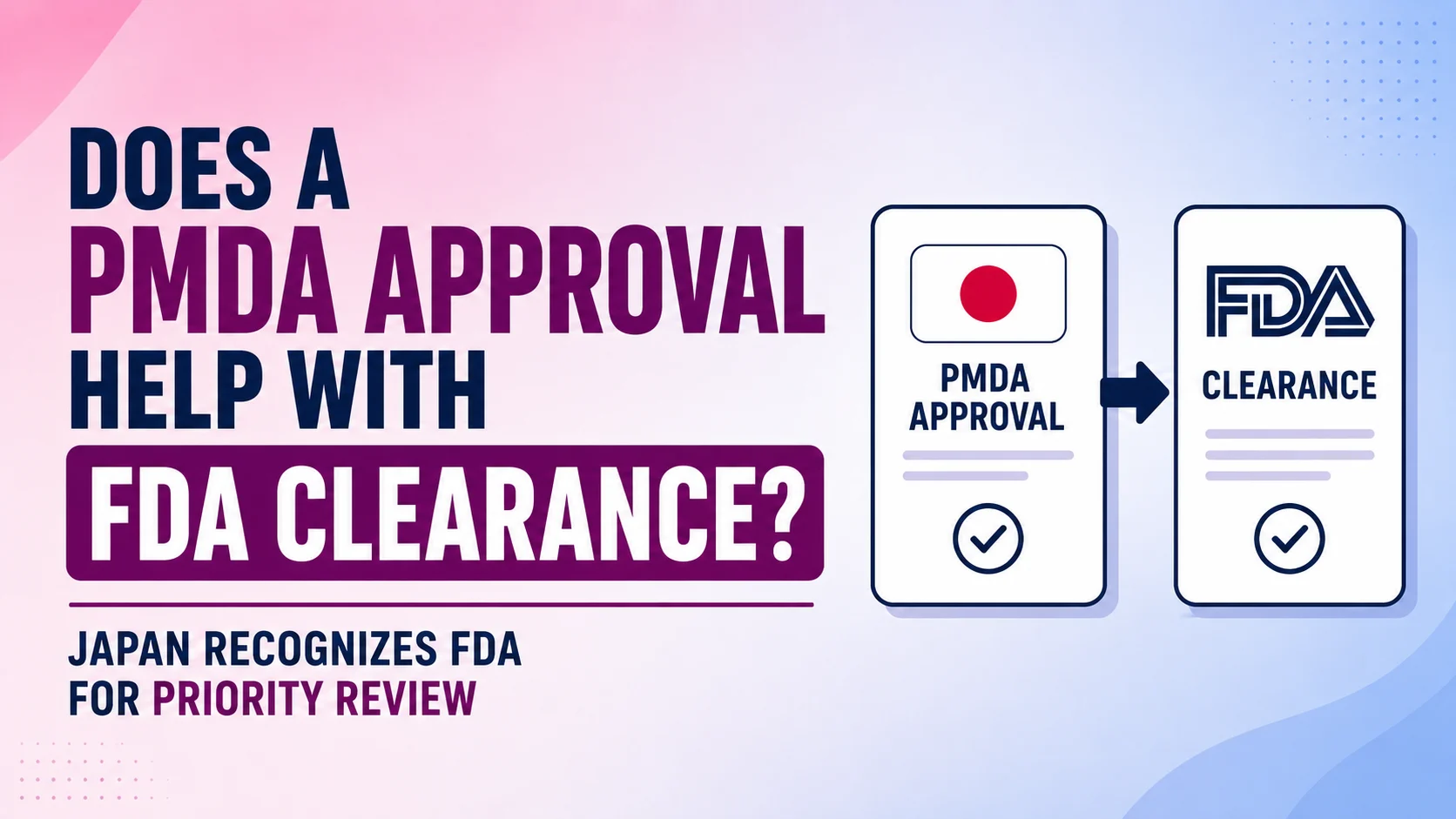
Quick Answer: A PMDA approval carries no legal weight at FDA. There is no mutual recognition agreement obligating FDA to accept Japanese regulatory decisions, and FDA grants clearance through a 510(k), not "approval." Japan's side of the relationship has moved further than most: under Cabinet Order No. 362, effective 1 May 2026, Japan's Ministry of Health, Labour and Welfare designated the US as the only country whose device and IVD approvals it treats as equivalent to its own for priority review. That sounds broader than it is. The mechanism applies only to devices in short supply in Japan, requires an existing, matching Japanese predicate device regardless of FDA status, and the specialists tracking it describe it as "a first step," not a general reliance framework. None of that changes what FDA requires from a Japanese manufacturer. What transfers on your side is evidence: an ISO 13485-certified quality system aligns with FDA's Quality Management System Regulation (QMSR), effective since 2 February 2026.
A real first step, and exactly how narrow it is
On 31 October 2025, Japan's MHLW published Cabinet Order No. 362, revising the enforcement order of the Pharmaceuticals and Medical Devices Act, effective 1 May 2026. Among its changes, MHLW designated countries whose marketing approval systems it recognizes as equivalent to Japan's own, for priority review purposes. For pharmaceuticals and regenerative medicine products, five countries qualify: the US, UK, Canada, Germany, and France. For medical devices and in vitro diagnostics specifically, only one does: the United States. It's a genuine, first-of-its-kind step, and Japan drew the circle around FDA alone.
Read the actual conditions before drawing conclusions. A follow-up MHLW notification, issued 31 March 2026, spells out the scope: priority review under this mechanism applies to devices facing a supply shortage in Japan specifically, where existing Japanese-market devices can't meet demand, where the device already holds valid FDA authorization, and where MHLW agrees through its own consultation process that the device qualifies. Separately, the device must match an existing Japanese-registered predicate on classification code and key properties. FDA authorization unlocks review speed for a supply-shortage situation; it doesn't waive Japan's own predicate requirement or open a general fast lane for FDA-cleared devices entering Japan. The specialists who first flagged this change to industry describe it, in their own words, as a first step for regulatory reliance at MHLW, not an established pathway.
None of this touches the direction that matters for a Japanese manufacturer targeting the US. FDA has no equivalent mechanism recognizing PMDA decisions, narrow or otherwise. This is the same asymmetry we've documented in Malaysia's and Taiwan's recent trade agreements with the US, and Japan's version arrived through a different route entirely — a unilateral domestic order rather than a bilateral trade deal — which makes it a third independent example of the same one-way pattern.
Why Japan looks different from the rest of this cluster, and why that still doesn't help you
Japan's international standing is genuinely unusual among the countries we've covered. It's one of MDSAP's five full Members, the same tier as the US, Canada, Brazil, and Australia, not an Affiliate Member like Korea or Malaysia. It co-chaired the International Medical Device Regulators Forum in 2025, immediately after the US held the role in 2024. FDA and PMDA run a long-standing joint program, Harmonization By Doing, coordinating device trial design across both countries since the 2010s. PMDA opened its first US office, in Washington, D.C., on 1 November 2024, its second overseas office after Bangkok, specifically to deepen contact with US manufacturers and FDA staff.
None of that changes the mechanics of a 510(k) review. Full MDSAP membership means Japan's own regulator mutually accepts MDSAP audits from the program's other full Members for routine surveillance purposes — the same manufacturer-level logic that applies to Korea's Affiliate-tier participation, just with Japan sitting at a higher tier of the same program. It says nothing about FDA accepting a PMDA product decision. IMDRF co-chairmanship and joint trial-design work are genuine, valuable regulatory diplomacy. Neither one substitutes for your own 510(k) submission.
Three pathways, and a materially different in-country role
Japan classifies devices Class I through IV and routes them through three distinct pathways depending on class and whether an established certification standard exists. Class I devices go through todokede, a simple notification filed with the local prefectural government, not PMDA or MHLW, comparable to FDA's Class I listing. Class II and III devices with an established certification standard go through ninsho, certification by a Registered Certification Body, a private body authorized by MHLW. Class IV devices, and Class II/III devices without an established standard, require shonin: full MHLW approval following PMDA's own product review. None of these pathways maps directly onto FDA's three-class system, and confirming your US classification and product code remains a separate, first-principles exercise.
The in-country role is also structurally different from what we've covered elsewhere in this cluster. Foreign manufacturers cannot apply to PMDA directly. A Japanese Marketing Authorization Holder, or a Designated MAH for foreign manufacturers, must actually hold the license in Japan, not merely represent the manufacturer the way a Local Agent or Authorised Representative does elsewhere. That's a materially more involved relationship than a US Agent, who represents a foreign manufacturer to FDA without holding anything. The two roles aren't equivalent, and having an MAH in Japan does nothing for your FDA obligations.
What genuinely transfers, and what doesn't: quality system, testing, and predicates
The QMSR took effect 2 February 2026 and incorporates ISO 13485:2016 by reference into 21 CFR Part 820. An ISO 13485-certified quality system now substantially aligns with FDA's expectations, with the usual caveat: the certificate isn't accepted in place of an FDA inspection. An MDSAP audit report is, and Japan's full MDSAP membership means Japanese manufacturers already have straightforward access to that audit route.
Japan's national lab accreditation body, JAB (Japan Accreditation Board), accredits testing laboratories under ISO/IEC 17025 and is a full member of the ILAC Mutual Recognition Arrangement. That's genuine, internationally recognized competence, structurally the same credibility NABL carries in India or TAF carries in Taiwan. It isn't an FDA recognition scheme. FDA evaluates whether your testing followed the FDA-recognized standard and version on your finished device, not which national body accredited the lab that ran it. Mapping which of your existing JAB-accredited test reports actually satisfy FDA's specific requirements, rather than assuming they transfer wholesale, is exactly the kind of gap analysis Complizen's Superagent platform is built to run against your real submission file.
What doesn't transfer, in either direction, is your predicate. Whatever pathway got your device to market in Japan, FDA's substantial equivalence requirement still calls for a device already legally marketed in the United States. This is true even under Cabinet Order 362's own logic: that mechanism requires an existing Japanese predicate for a device to qualify, and the reverse is equally true at FDA. Japan's predicate pool and FDA's predicate pool are independent, the same principle we've covered for CDSCO and every other regulator in this cluster.
Fees and timelines: unaffected by any of this
FDA fees don't vary by country of origin. In FY2027, running 1 October 2026 through 30 September 2027, a standard 510(k) is $28,653, or $7,163 with small business status, and annual establishment registration is $13,785 with no small business reduction. Japanese manufacturers qualify for small business status through a National Taxing Authority Certification from their own country's tax authority rather than a US tax return. FDA requires this at least 60 days before the fee is due and won't refund the difference if you pay standard and qualify later.
The review clock is equally unaffected. Nothing about Japan's Cabinet Order, MDSAP membership, or IMDRF role changes FDA's own timeline. FDA's MDUFA V goal remains a decision within 90 FDA days for 95% of 510(k) submissions, and that clock pauses whenever FDA is waiting on you, most commonly during an Additional Information request. PMDA's own review timelines, whichever of the three pathways applies, run entirely independently.
Common mistakes
Assuming Cabinet Order 362 creates a general fast lane for FDA-cleared devices in Japan. It's limited to supply-shortage situations and still requires a matching Japanese predicate.
Assuming Japan's deep regulatory ties to the US create anything reciprocal for your FDA submission. IMDRF co-chairmanship, MDSAP membership, and joint trial programs are real, and none of them touch how FDA reviews your 510(k).
Treating a Marketing Authorization Holder as equivalent to a US Agent. An MAH holds your Japanese license. A US Agent only represents you to FDA. The roles aren't interchangeable.
Assuming a Japan-registered predicate helps your FDA search, or vice versa. Each regulator's predicate pool is independent of the other's.
Registering a US establishment before there's a US buyer. It's a distribution requirement, not a submission requirement, and it starts an annual fee for no immediate benefit.
Frequently asked questions
Does a PMDA approval help with FDA clearance? Not as a credential. There's no mutual recognition agreement obligating FDA to accept PMDA decisions. What helps is the evidence behind a PMDA file: an ISO 13485-certified quality system aligns with FDA's QMSR, and JAB-accredited testing carries real credibility, though FDA's acceptance still depends on the specific standard tested.
What is Japan's Cabinet Order No. 362? An MHLW order, published 31 October 2025 and effective 1 May 2026, that formally designates the US FDA an equivalent regulatory authority for priority review. It's narrowly scoped: it applies only to devices in short supply in Japan that already hold FDA authorization and match an existing Japanese predicate device.
Does Cabinet Order 362 mean FDA-cleared devices get fast-tracked into Japan? Only under specific conditions. The device must address a genuine supply shortage in Japan, hold valid FDA authorization, and match an existing Japanese-registered predicate on classification and key properties. It isn't a general recognition of FDA clearance for ordinary market entry.
Does FDA recognize PMDA approvals? No. Nothing in Japan's recent regulatory reliance steps creates a reciprocal mechanism at FDA. A Japanese manufacturer must submit its own 510(k), PMA, or De Novo request regardless of PMDA status.
Is Japan an MDSAP member? Yes, and at the highest tier. Japan is one of MDSAP's five full Members, alongside the US, Canada, Brazil, and Australia. That's a different, stronger form of participation than Korea's or Malaysia's Affiliate Member status, though it governs mutual acceptance of manufacturer-level quality audits, not product approval decisions.
What is a Marketing Authorization Holder, and is it the same as a US Agent? No. A Marketing Authorization Holder, or Designated MAH for foreign manufacturers, is a Japanese legal entity that holds your device's license in Japan. A US Agent only represents a foreign manufacturer to FDA and holds nothing. The two roles serve different regulators with different legal weight.
Will FDA accept test data from a JAB-accredited Japanese lab? It can, on the same basis as testing from any lab anywhere. JAB accreditation under ISO/IEC 17025, recognized through the ILAC Mutual Recognition Arrangement, is a genuine quality signal. FDA's acceptance depends on whether the specific test followed the FDA-recognized standard and version for your device type, not on which national body accredited the lab.
What does FDA clearance cost for a Japanese manufacturer? The same published fees as any manufacturer. In FY2027, a standard 510(k) is $28,653, or $7,163 with small business status, plus $13,785 for annual establishment registration. Japanese manufacturers qualify for small business status through a National Taxing Authority Certification from their own tax authority rather than a US tax return.
Is Japan on WHO's list of transitional Listed Authorities for medical devices? Yes. MHLW/PMDA is one of the twelve authorities on WHO's July 2026 tWLA list, the same list that includes the US FDA. Being listed alongside FDA doesn't create any recognition between the two; each entry on that list describes standing independently, not a relationship between listed authorities.
Which pathway applies to my device in Japan: todokede, ninsho, or shonin? It depends on your device's class and whether an established certification standard exists for it. Class I devices generally use todokede notification. Class II and III devices with an established standard use ninsho certification through a Registered Certification Body. Class IV devices, and Class II/III devices without an established standard, require shonin approval from MHLW following PMDA review.
Key takeaways
A real mechanism now exists, and it's narrower than headlines suggest. Cabinet Order 362 gives FDA-authorized devices priority review in Japan only for supply shortages, only with a matching Japanese predicate. Treat it as a first step, per the specialists who tracked it, not a general pathway.
Japan's global standing is real and still doesn't reach back to FDA. Full MDSAP membership, IMDRF co-chairmanship, and joint trial programs with FDA are genuine. None of them changes what your own 510(k) submission requires.
The in-country role is heavier than elsewhere in this cluster. A Marketing Authorization Holder holds your license in Japan; a US Agent only represents you. Don't treat the two as equivalent.
Predicates stay independent in both directions. Cabinet Order 362 itself requires a Japanese predicate match. FDA requires a US-marketed one. Neither pool substitutes for the other.
QMSR remains the genuine cross-cutting advantage. If you hold ISO 13485, your quality system substantially aligns with FDA's expectations since February 2026, though a certificate still isn't accepted in place of inspection the way an MDSAP report is.
Complizen helps international medical device manufacturers reach FDA 510(k) clearance, combining a software platform for in-house regulatory teams with full-service consultancy for teams without in-house FDA expertise.
Working out which parts of a PMDA-facing file actually carry weight at FDA, rather than assuming Japan's international standing changes that answer, is worth settling early. Complizen's regulatory strategy engagement maps your device to a US pathway, product code, and predicate shortlist, reviewed by a senior FDA expert. See how the strategy service works →
References
- Emergo by UL — Japan Cabinet Order No. 362 Designates the US as Equivalent Regulatory Authority. https://www.emergobyul.com/news/japan-cabinet-order-no-362-designates-us-equivalent-regulatory-authority
- Emergo by UL — Update on Japan Cabinet Order No. 362 and MHLW Notification No. 0331-20 and US FDA Authorized Devices as Equivalent. https://www.emergobyul.com/news/update-japan-cabinet-order-no-362-and-mhlw-notification-no-0331-20-and-us-fda-authorized
- Shin Nippon Hoki — Legal summary of Cabinet Order No. 362 of 2025 (Reiwa 7), confirming the equivalent-country designations by product type (Japanese). https://www.sn-hoki.co.jp/article/pickup_hourei/pickup_hourei4458884/
- TMI Legal — Regulatory news tracking the promulgation and effective date of Cabinet Order No. 362 of 2025 (Japanese). https://www.tmi.gr.jp/eyes/blog/2025/17697.html
- ElendiLabs — Japan Adopts Regulatory Reliance: Priority Review for US FDA-Authorized Devices (secondary source; regulatory consultancy). https://www.elendilabs.com/en/articles/jpn-regulatory-reliance
- PMDA — PMDA Washington D.C. Office. https://www.pmda.go.jp/english/int-activities/overseas-office/dc/0001.html
- FDA — U.S.-Japan Regulatory Collaboration (Harmonization By Doing). https://www.fda.gov/medical-devices/cdrh-international-affairs/us-japan-regulatory-collaboration
- FDA — Medical Device Single Audit Program (MDSAP). https://www.fda.gov/medical-devices/cdrh-international-affairs/medical-device-single-audit-program-mdsap
- FDA — Quality Management System Regulation (QMSR). https://www.fda.gov/medical-devices/postmarket-requirements-devices/quality-management-system-regulation-qmsr
- FDA — MDUFA Performance Goals and Procedures, Fiscal Years 2023 Through 2027. https://www.fda.gov/media/73507/download
- Federal Register — Medical Device User Fee Rates for Fiscal Year 2027. https://www.federalregister.gov/documents/2026/07/30/2026-15335/medical-device-user-fee-rates-for-fiscal-year-2027
- WHO — List of transitional WHO Listed Authorities for medical devices (tWLAs-MD), as of 1 July 2026 (PDF). https://cdn.who.int/media/docs/default-source/medicines/regulatory-systems/wla/list-of-transitional-wlas_md.pdf
- Japan Accreditation Board (JAB) — Testing Laboratories (ISO/IEC 17025) accreditation programme. https://www.jab.or.jp/en/service/laboratory