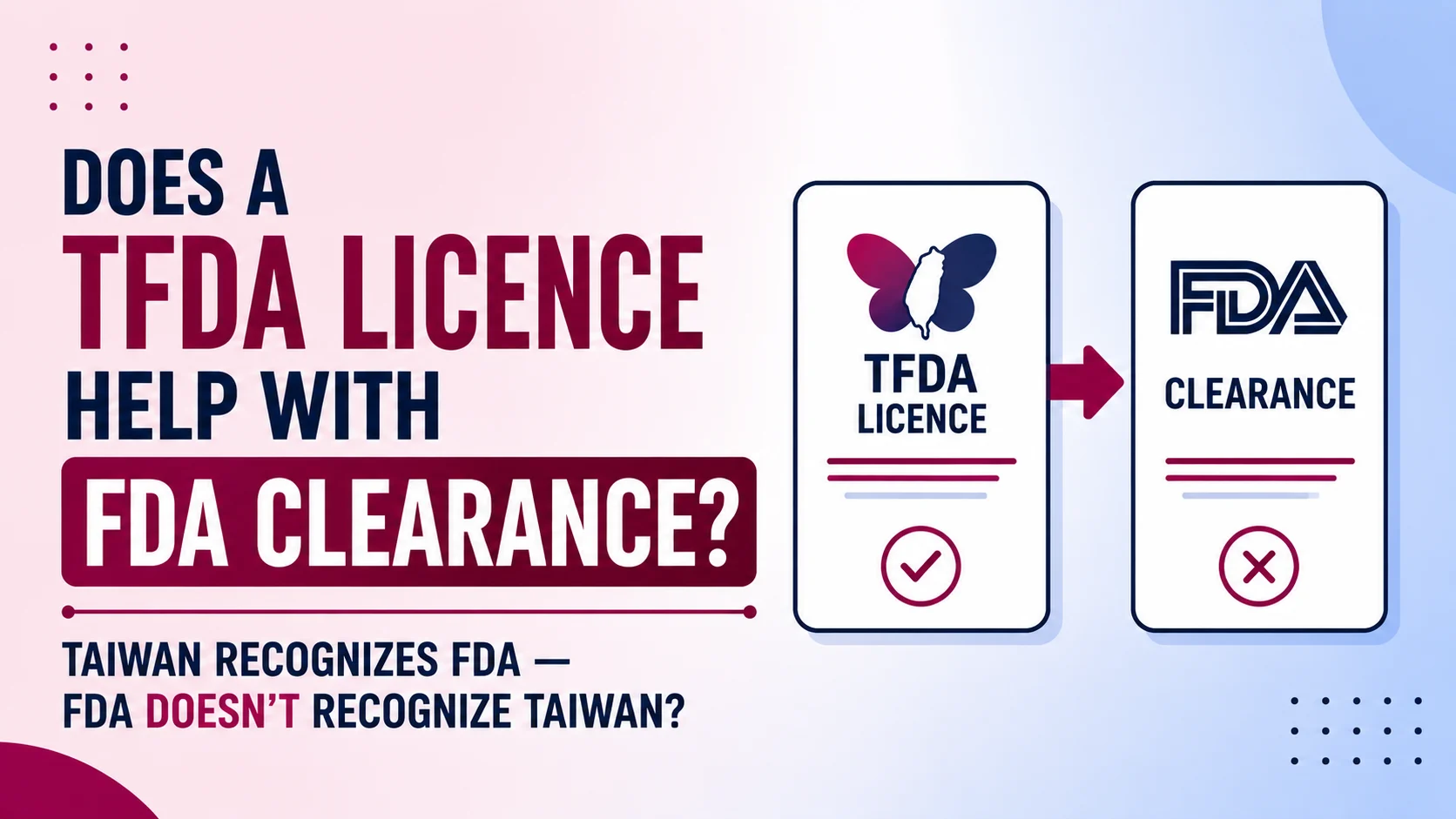
Quick Answer: A TFDA licence does not help with FDA clearance as a matter of law: it carries no legal weight at FDA. There is no mutual recognition agreement obligating FDA to accept TFDA decisions, and FDA grants clearance through a 510(k), not "approval." Taiwan's side of the relationship is more developed than most: TFDA already runs an abbreviated quality-system review for manufacturers with valid audit reports from recognized agencies, waives Free Sales Certificate notarization for US, Canadian, and Australian manufacturers, and, under the US-Taiwan Agreement on Reciprocal Trade signed 12 February 2026, committed to accept FDA marketing authorizations for devices manufactured in the United States without additional requirements. None of that runs the other way. FDA does not recognize TFDA approvals, and Taiwanese manufacturers must register separately with FDA regardless of their TFDA status. What transfers on your side is evidence: an ISO 13485-certified quality system aligns with FDA's Quality Management System Regulation (QMSR), effective since 2 February 2026, and TAF-accredited test data carries real credibility.
A real trade agreement, and a precise limit on what it does
On 12 February 2026, the United States and Taiwan signed the Agreement on Reciprocal Trade, following a memorandum of understanding from January. Under it, Taiwan committed to accept FDA marketing authorizations for medical devices and pharmaceuticals manufactured in the United States without additional requirements for entry into Taiwan's market. That's a genuine, government-to-government commitment, confirmed directly in the US Trade Representative's own fact sheet.
Read the scope carefully, because it's easy to overstate. The commitment covers devices manufactured in the United States entering Taiwan. It is not a general statement that Taiwan recognizes FDA clearance regardless of where a device is made, and it says nothing about the reverse direction. Industry reporting on the agreement's practical effect is precise about this: FDA approval may be used as supporting evidence in a TFDA application, but Taiwan will continue to conduct its own regulatory review. The agreement formalizes and strengthens Taiwan's existing posture toward FDA evidence. It doesn't replace TFDA's review with FDA's.
This isn't a one-off. Four months earlier, Malaysia signed its own Agreement on Reciprocal Trade with the US, committing Malaysia's MDA to accept FDA clearance on similar terms. Both agreements run the identical direction: the partner country recognizes FDA, and FDA recognizes nothing in return. Two separate trade deals, signed months apart, produced the same asymmetry. That's worth knowing if you're tracking how the US is using trade policy to extend FDA's reach abroad without ever agreeing to reciprocate.
For a Taiwanese manufacturer targeting the US market, the more relevant fact is the one this agreement doesn't touch: TFDA approval does not substitute for FDA registration. You still register separately with FDA and designate a US Agent, regardless of anything TFDA has decided about your device.
Taiwan also isn't among the twelve authorities on WHO's July 2026 list of transitional Listed Authorities for medical devices. FDA is. That's a second, independent framework showing the same pattern from a different angle.
Your predicate has to be TFDA-recognized in Taiwan, and FDA-recognized here
TFDA classifies devices into three risk-based classes, Class I through III, a different structure from the four-class systems used in India and Malaysia. Confirming your device's US classification and product code against FDA's own database remains a first-principles exercise regardless of your Taiwan classification.
The predicate question deserves particular care, because it's where an easy assumption goes wrong. In Taiwan, a foreign SE (substantially equivalent) device can help demonstrate similarity, but it does not guarantee TFDA will treat your device as having a predicate. TFDA requires its own TFDA-approved comparator. At FDA, the same principle runs the other direction: choosing a US predicate means finding a device already legally marketed in the United States. Neither regulator's predicate pool does anything for the other's requirement. A device with a clean predicate story in Taiwan may still need a completely separate search at FDA, and vice versa. It's the same lesson we've covered for manufacturers coming from CE Mark, CDSCO, and MFDS files: predicates and evidence built for one regulator answer that regulator's question, not FDA's.
One sequencing note specific to Taiwan: Class II and III devices generally need approval from their country of origin before TFDA registration. That's a dependency on your home-market approval, not on FDA specifically, but it's worth planning around if Taiwan is also a target market.
What genuinely transfers: quality system and testing evidence
The Quality Management System Regulation took effect on 2 February 2026 and incorporates ISO 13485:2016 by reference into 21 CFR Part 820. If your quality system is ISO 13485-certified, which TFDA also requires for Quality System Documentation (QSD) purposes on most device classes, that certification now substantially aligns with FDA's own expectations. The usual caution still applies: a certificate is not accepted in lieu of an FDA inspection. An MDSAP audit report is.
TFDA separately offers manufacturers in the US, EU, and Japan an abbreviated QSD pathway when valid audit reports from recognized regulatory agencies are provided, reducing Taiwan-side review time. For US manufacturers specifically, a TFDA announcement on QSD documentation permits an FDA Establishment Inspection Report issued within the past three years, paired with a Certificate to Foreign Government issued within the past two, to replace the full quality manual and procedure set otherwise required; manufacturers without a recent EIR can submit an MDSAP audit report instead. That's a real, useful efficiency, entirely internal to Taiwan's process, and it has no bearing on what FDA expects from your submission.
Taiwan's national lab accreditation body, TAF (Taiwan Accreditation Foundation), accredits testing laboratories under ISO/IEC 17025 and is a signatory to the ILAC Mutual Recognition Arrangement. That's genuine, internationally recognized technical competence, the same structural credibility NABL carries in India or KOLAS carries in Korea. It isn't a formal FDA recognition scheme. What matters to FDA review is whether your testing followed the FDA-recognized version of the relevant standard, on your finished device, with complete documentation, not which national body accredited the lab. A TAF-accredited lab is well positioned to produce that kind of data; confirming the specific tests and standard versions actually match what your predicate and product code require is a separate exercise, and one worth doing deliberately rather than assuming. That gap analysis, mapping your existing evidence against FDA's actual requirements, is what Complizen's Superagent platform is built to run against your real file.
Two different in-country roles
Taiwan requires foreign manufacturers to appoint a Local Responsible Party, sometimes referred to as a Taiwan Agent, for TFDA purposes. FDA separately requires a US Agent for any foreign manufacturer distributing in the United States. Having a Taiwan Agent in place does nothing for your FDA obligations, and the reverse holds too. As with any foreign manufacturer, US Agent designation and establishment registration are conditions of commercial distribution, not of 510(k) clearance.
What it costs at FDA in FY2027
FDA fees don't vary by country of origin. In FY2027, running 1 October 2026 through 30 September 2027, a standard 510(k) is $28,653, or $7,163 with small business status, and annual establishment registration is $13,785 with no small business reduction. Foreign manufacturers, including Taiwanese ones, qualify for small business status through a National Taxing Authority Certification from their own country's tax authority rather than a US tax return, confirming gross receipts in both local currency and US dollars. FDA requires this at least 60 days before the fee is due and won't refund the difference if you pay standard and qualify later.
Two clocks, unaffected by trade policy
Nothing in the February 2026 agreement changes FDA's own review clock. FDA's MDUFA V goal remains a decision within 90 FDA days for 95% of 510(k) submissions, and that clock pauses whenever FDA is waiting on you, most commonly during an Additional Information request. Whatever TFDA's own review timelines look like for your device, they run independently of FDA's, in both directions.
Common mistakes
Assuming the 2026 trade agreement changes FDA's requirements for Taiwanese manufacturers. It changes what Taiwan requires of US-manufactured devices entering Taiwan. It says nothing about the reverse.
Assuming a Taiwan-approved device or predicate carries weight at FDA, or vice versa. Each regulator requires its own recognized comparator. Neither pool substitutes for the other.
Treating TAF accreditation as an FDA acceptance guarantee. It's a real, internationally recognized quality signal. FDA still evaluates the specific standard and version tested.
Confusing a Local Responsible Party with a US Agent. Two roles, two regulators, no substitution.
Registering a US establishment before there's a US buyer. It's a distribution requirement, not a submission requirement, and it starts an annual fee for no immediate benefit.
Frequently asked questions
Does a TFDA licence help with FDA clearance? Not as a credential. There's no mutual recognition agreement obligating FDA to accept TFDA decisions. What helps is the evidence behind a TFDA file: an ISO 13485-certified quality system aligns with FDA's QMSR, and TAF-accredited testing carries real credibility, though FDA's acceptance still depends on the specific standard tested.
Does the 2026 US-Taiwan trade agreement mean Taiwanese manufacturers get faster FDA review? No. The agreement commits Taiwan to accept FDA marketing authorizations for devices manufactured in the United States, entering the Taiwan market. It doesn't create any reciprocal FDA pathway for Taiwanese manufacturers, and FDA's own review process is unchanged.
Does FDA recognize TFDA approvals? No. TFDA approval does not substitute for FDA registration. Taiwanese manufacturers must register separately with FDA and designate a US Agent, regardless of their TFDA status.
Can I use my TFDA predicate for my FDA submission, or an FDA predicate for my TFDA submission? Neither transfers directly. TFDA requires its own TFDA-approved comparator device; a foreign SE device may help demonstrate similarity but doesn't guarantee predicate status there. FDA requires a device already legally marketed in the United States. Each regulator's predicate pool is independent of the other's.
What is TFDA's abbreviated QSD pathway? An expedited quality-system review available to manufacturers in the US, EU, and Japan who provide valid audit reports from recognized regulatory agencies. It reduces Taiwan-side review time and has no bearing on FDA's own requirements.
Will FDA accept test data from a TAF-accredited Taiwanese lab? It can, on the same basis as testing from any lab anywhere. TAF accreditation under ISO/IEC 17025, recognized through the ILAC Mutual Recognition Arrangement, is a genuine quality signal. FDA's acceptance depends on whether the specific test followed the FDA-recognized standard and version for your device type, not on which national body accredited the lab.
Do I need a US Agent if I already have a Local Responsible Party for TFDA? Yes, separately. An LRP satisfies TFDA's requirement for a locally based contact in Taiwan. FDA requires its own US Agent for any foreign manufacturer distributing in the United States. Neither substitutes for the other.
What does FDA clearance cost for a Taiwanese manufacturer? The same published fees as any manufacturer. In FY2027, a standard 510(k) is $28,653, or $7,163 with small business status, plus $13,785 for annual establishment registration. Taiwanese manufacturers qualify for small business status through a National Taxing Authority Certification from their own tax authority rather than a US tax return.
Does my device need country-of-origin approval before I can register with TFDA? For Class II and III devices, generally yes. TFDA typically expects approval from the device's country of origin before Taiwan registration, separate from and unrelated to any FDA timeline.
Is Taiwan's medical device classification the same as FDA's? Structurally similar but not identical. TFDA uses three risk-based classes, the same number as FDA, but the boundaries differ. Classification has to be confirmed independently against FDA's own product code database rather than inferred from your TFDA class.
Key takeaways
A real trade agreement now formalizes part of this relationship, in one direction only. Taiwan committed to accepting FDA authorizations for US-manufactured devices. Nothing obligates FDA to accept TFDA decisions in return.
QMSR is the genuine cross-cutting advantage, if you hold ISO 13485. Since February 2026, your quality system substantially aligns with FDA's expectations, though a certificate still isn't accepted in place of inspection the way an MDSAP report is.
Predicates don't cross borders in either direction. TFDA requires its own recognized comparator; FDA requires a US-marketed one. A clean predicate story in one country says nothing about the other.
TFDA approval doesn't substitute for FDA registration. You register separately, with your own US Agent, regardless of your Taiwan status.
The trade agreement doesn't touch FDA's clock. MDUFA V goals and Taiwan's own review timelines remain entirely independent processes.
Complizen helps international medical device manufacturers reach FDA 510(k) clearance, combining a software platform for in-house regulatory teams with full-service consultancy for teams without in-house FDA expertise.
Working out which parts of a Taiwan-facing file actually carry weight at FDA, rather than assuming recent trade news changes that answer, is the higher-leverage question to settle early. Complizen's regulatory strategy engagement maps your device to a US pathway, product code, and predicate shortlist, reviewed by a senior FDA expert. See how the strategy service works →
References
- Office of the United States Trade Representative — Fact Sheet on U.S.-Taiwan Agreement on Reciprocal Trade. https://ustr.gov/about/policy-offices/press-office/fact-sheets/2026/february/fact-sheet-us-taiwan-agreement-reciprocal-trade
- Pacific Bridge Medical — Quick Asia Regulatory Updates (April 2026). https://www.pacificbridgemedical.com/news-brief/quick-asia-regulatory-updates-april-2026/
- Regovant — FDA Registration for Taiwan Exporters: Complete 2026 Guide (secondary source; regulatory consultancy). https://www.regovant.com/fda-registration-taiwan
- MedDeviceGuide — Taiwan TFDA Medical Device Registration Guide 2026 (secondary source). https://meddeviceguide.com/blog/taiwan-tfda-medical-device-registration-guide
- ElendiLabs — Taiwan TFDA Medical Device Regulation Overview: Classification, Registration, and Market Approval (secondary source; regulatory consultancy). https://elendilabs.com/en/articles/twn-tfda-medical-device-regulatory-overview
- FDA — Quality Management System Regulation (QMSR). https://www.fda.gov/medical-devices/postmarket-requirements-devices/quality-management-system-regulation-qmsr
- FDA — Medical Device Single Audit Program (MDSAP). https://www.fda.gov/medical-devices/cdrh-international-affairs/medical-device-single-audit-program-mdsap
- FDA — MDUFA Performance Goals and Procedures, Fiscal Years 2023 Through 2027. https://www.fda.gov/media/73507/download
- Federal Register — Medical Device User Fee Rates for Fiscal Year 2027. https://www.federalregister.gov/documents/2026/07/30/2026-15335/medical-device-user-fee-rates-for-fiscal-year-2027
- Taiwan Accreditation Foundation (TAF) — ISO/IEC 17025 Testing Laboratory accreditation programme. https://www.taftw.org.tw/en/getting-accredited/field/