FDA regulates medical devices through its Center for Devices and Radiological Health (CDRH). Most devices reach the US market through one of three premarket pathways: 510(k) clearance, De Novo classification or premarket approval (PMA). Which one applies depends on your device's risk class and whether a similar device is already legally on the market.
This guide explains who reviews your submission, how to choose a pathway, what FDA charges, how long reviews take and what has changed recently. It is written for manufacturers, including international companies selling into the US for the first time.
Key takeaways
- Most moderate-risk (Class II) devices use the 510(k) pathway. FDA cleared 3,198 510(k)s in 2025, based on our count of FDA's 510(k) database.
- De Novo is for novel low-to-moderate-risk devices with no predicate. PMA is for high-risk (Class III) devices and usually needs clinical data.
- FDA's review goals are 90 FDA days for a 510(k), 150 for a De Novo and 180 for a PMA. FDA days stop counting while FDA waits for your answers.
- From October 1, 2026, the standard 510(k) user fee is $28,653, or $7,163 for qualifying small businesses.
- The Quality Management System Regulation (QMSR), which aligns FDA's quality rules with ISO 13485:2016, took effect on February 2, 2026.
Who regulates medical devices at FDA?
CDRH regulates medical devices and radiation-emitting products sold in the United States. Within CDRH, the Office of Product Evaluation and Quality (OPEQ) reviews premarket submissions and oversees device quality after launch.
OPEQ is organized into eight Offices of Health Technology (OHTs). Your submission goes to the office that covers your device type:
- OHT1: Ophthalmic, Anesthesia, Respiratory, ENT and Dental Devices
- OHT2: Cardiovascular Devices
- OHT3: Reproductive, Gastro-Renal, Urological, General Hospital Device and Human Factors
- OHT4: Surgical and Infection Control Devices
- OHT5: Neurological and Physical Medicine Devices
- OHT6: Orthopedic Devices
- OHT7: In Vitro Diagnostics
- OHT8: Radiological Health
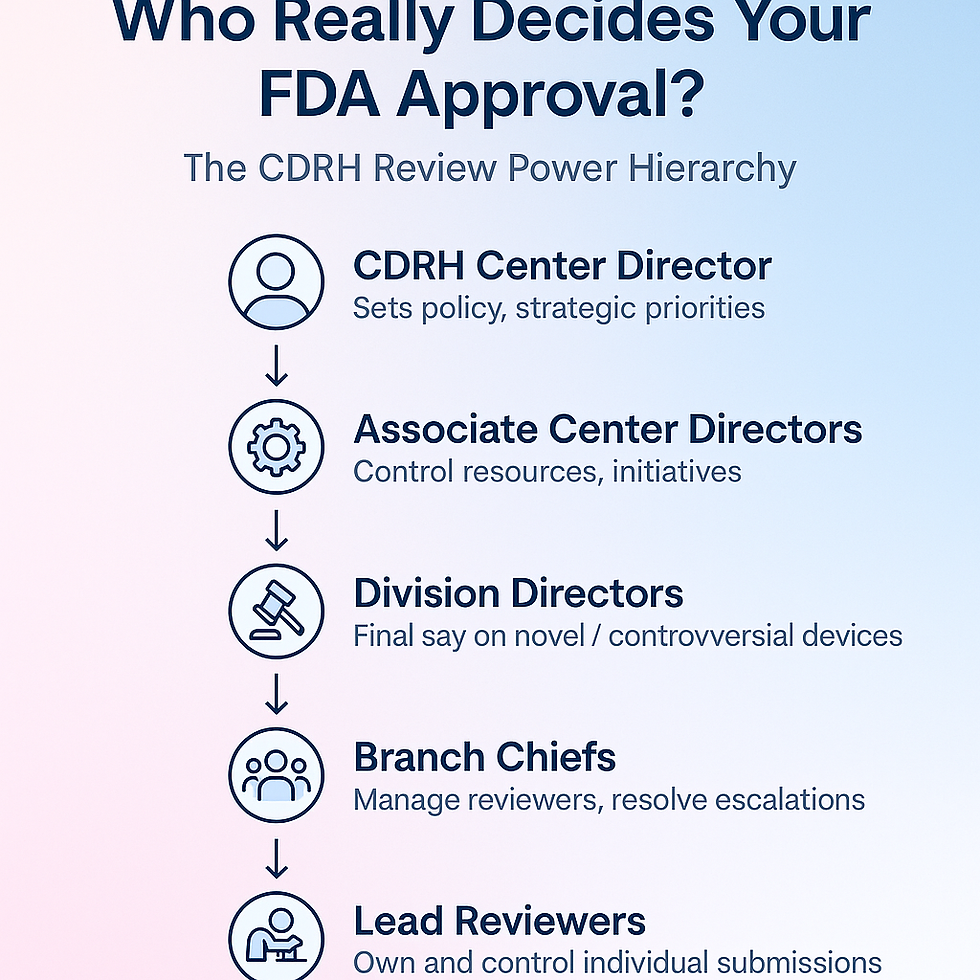
A lead reviewer manages your submission and brings in specialists, for example for software, biocompatibility or cybersecurity. Supervisors sign off on decisions, and novel or complex cases go up to division or office leadership. Knowing which office will review you lets you study its past decisions before you submit.
What are the three FDA pathways to market?
Your device's class (I, II or III) and whether a predicate exists decide the pathway. Start by confirming your class in our device classification guide. Most Class I and some Class II devices are exempt from premarket review altogether.
| Pathway | When it fits | Legal basis | FDA review goal (MDUFA V) | Standard fee from Oct 1, 2026 |
|---|---|---|---|---|
| 510(k) | A legally marketed predicate exists and your device is substantially equivalent to it | 21 CFR 807, Subpart E | 90 FDA days | $28,653 |
| De Novo | Novel device, low to moderate risk, no predicate | 21 CFR 860, Subpart D | 150 FDA days | $191,020 |
| PMA | High-risk (Class III) devices | 21 CFR 814 | 180 FDA days | $636,732 |
510(k): substantial equivalence to a predicate
A 510(k) shows that your device is as safe and effective as a legally marketed device, called a predicate. It must have the same intended use. Its technological characteristics must either match the predicate's or differ in ways that don't raise new questions of safety and effectiveness.
It is by far the most common pathway. FDA's 510(k) database records 3,299 clearances in 2023, 3,082 in 2024 and 3,198 in 2025 (our count via openFDA). Most rely on bench and performance testing rather than clinical data.
Your most important decision is the predicate. See how to find a predicate device and how FDA judges substantial equivalence.
De Novo: a new classification for novel devices
De Novo is for novel devices of low to moderate risk that have no predicate. If FDA grants the request, it creates a new classification regulation, and your device becomes a predicate that later devices can cite. See our De Novo pathway guide.
PMA: premarket approval for high-risk devices
PMA is FDA's most demanding pathway. You must show reasonable assurance of safety and effectiveness with valid scientific evidence, which usually means clinical data. FDA also typically inspects manufacturing sites before approval. See our PMA guide.
How do you choose the right pathway?
Choose 510(k) when:
- A clear, strong predicate exists
- Your technology is an incremental change
- Your safety profile matches devices already on the market
Choose De Novo when:
- Your technology is novel but low to moderate risk
- No predicate exists, and PMA would be out of proportion to the risk
- You want to create a new device category
Choose PMA when:
- Your device is Class III, such as many implantable or life-sustaining devices
- Its risks call for clinical proof of safety and effectiveness
Still unsure? A 513(g) request asks FDA for its view on your device's classification and requirements. From October 1, 2026 it costs $8,596, or $4,298 for small businesses. Compare the options in 510(k) vs De Novo vs PMA, or try our free pathway finder.
How much does FDA charge in user fees?
FDA sets user fees each fiscal year under the Medical Device User Fee Amendments (MDUFA). Each fiscal year starts on October 1.
| Fee | FY 2026 (to Sep 30, 2026) | FY 2027 (from Oct 1, 2026) | FY 2027 small business |
|---|---|---|---|
| 510(k) | $26,067 | $28,653 | $7,163 |
| De Novo request | $173,782 | $191,020 | $47,755 |
| PMA | $579,272 | $636,732 | $159,183 |
| 513(g) request | $7,820 | $8,596 | $4,298 |
| Annual establishment registration | $11,423 | $13,785 | No reduced rate (hardship waiver possible) |
Source: FDA, MDUFA fees.
Two ways to reduce fees:
- Small business status. Companies with gross receipts or sales of $100 million or less, including affiliates, can qualify for reduced fees through FDA's Small Business Determination program. Foreign companies can qualify too, with certification from their national tax authority.
- Third-party review. FDA charges no user fee for a 510(k) submitted through an FDA-accredited third-party reviewer. The reviewer charges its own fee. See our third-party review guide.
User fees are only one part of the budget. Testing, documentation and preparation add to it, and how much depends on your device. See our 510(k) cost breakdown and free fee calculator.
How long does FDA review take?
FDA's MDUFA V goals are measured in FDA days. The clock stops whenever FDA puts your submission on hold, for example while you answer an additional information (AI) request. Calendar time is therefore longer than the goal.
- Acceptance review: FDA screens a 510(k) for completeness within 15 calendar days. An incomplete submission is put on hold.
- Substantive review: FDA aims to either decide or send an AI request within 60 days.
- AI response window: you have 180 calendar days to answer an AI request on a 510(k). If you miss it, FDA considers the submission withdrawn.
A complete, well-organized submission is the most reliable way to shorten your timeline. Our guide to responding to FDA AI requests covers the most common deficiencies.
What has changed recently?
The QMSR replaced the Quality System Regulation
Since February 2, 2026, FDA's quality system rules in 21 CFR Part 820 incorporate ISO 13485:2016 by reference. Manufacturers certified to ISO 13485 start closer to compliance, but FDA-specific requirements still apply. See our QMSR guide.
Cybersecurity is a legal requirement for connected devices
Section 524B of the FD&C Act requires "cyber devices" to include a plan for postmarket vulnerabilities, cybersecurity processes and a software bill of materials (SBOM) in premarket submissions. FDA consolidated its expectations in final guidance issued on June 27, 2025. For cyber devices, FDA can refuse to accept a submission that lacks this information. See our FDA cybersecurity guide.
AI-enabled devices have their own guidance
In December 2024, FDA finalized guidance on predetermined change control plans (PCCPs), which let you get planned updates to AI models authorized in advance. In January 2025, it issued draft guidance on marketing submissions for AI-enabled device software functions. See our PCCP guide and AI and machine learning review guide.
eSTAR is mandatory for 510(k) and De Novo submissions
Since October 1, 2023, 510(k)s must use FDA's electronic submission template, eSTAR. De Novo requests followed on October 1, 2025. See our eSTAR guide.
User fees are being renegotiated
MDUFA V runs until September 30, 2027. Its successor, MDUFA VI, will set fees and review goals from October 2027.
How can you get feedback from FDA before you submit?
FDA's Q-Submission program lets you ask questions before and during a submission. There is no user fee.
- Pre-Submission (Pre-Sub): written feedback, with an optional meeting, on your planned testing, predicate or clinical strategy. FDA aims to send written feedback within 70 days.
- Submission Issue Request (SIR): feedback on your plan to fix issues FDA raised in a letter, such as an AI request.
- Study Risk Determination: FDA's view on whether a planned clinical study is significant risk or non-significant risk.
- Informational meeting: a chance to brief FDA on a device or program without asking for feedback.
A Pre-Sub is most valuable for novel technology, unclear predicates or planned clinical studies. See our Q-Submission guide. The Breakthrough Devices Program offers more frequent interaction and prioritized review for eligible devices. It is not a separate pathway: you still file a 510(k), De Novo or PMA. See our Breakthrough Devices guide.
What do international manufacturers need to know?
- US Agent: every foreign establishment must designate a US Agent who lives in, or has a place of business in, the United States. See our US Agent guide.
- Registration timing: establishment registration and device listing are required before you begin commercial distribution in the US, not before 510(k) clearance. See our registration and listing guide.
- Foreign approvals don't transfer: a CE mark or home-country licence does not replace FDA clearance, though some test data can be reused. See what a CE mark transfers to a 510(k).
- Quality systems: the QMSR applies to foreign manufacturers of finished devices sold in the US, and FDA inspects foreign sites.
For the most common missteps, read US market entry mistakes international manufacturers make.
Where can you research competitors and predicates?
FDA publishes its decisions. Use them before you commit to a strategy:
- 510(k), De Novo and PMA databases: find predicates, compare indications for use and see what similar devices submitted.
- Product classification database: confirm your product code, device class and review panel.
- MAUDE and recalls: see which failures FDA already knows about in your device type.
- Warning letters and Form 483s: see what FDA investigators cite during inspections.
Our FDA databases guide explains each one. See also FDA warning letters and Form 483 observations.
Which mistakes delay FDA clearance most?
- A weak predicate. If your differences raise new questions of safety or effectiveness, FDA can find your device not substantially equivalent. You may then need a De Novo or PMA.
- Incomplete testing. Gaps in biocompatibility, software, electrical safety or cybersecurity evidence lead to AI requests.
- Skipping early feedback. A Pre-Sub can settle testing and predicate questions before they become deficiencies.
- Quality system gaps. For PMA devices, problems found in the pre-approval inspection can delay approval.
What should you do next?
This week:
- Confirm your device's classification and product code.
- Shortlist possible predicates in FDA's 510(k) database.
- Identify which Office of Health Technology will review you.
- Decide whether a Pre-Sub is worth requesting.
Next 90 days:
- Map your testing plan against your predicate and FDA-recognized standards.
- Close QMSR gaps in your quality system.
- If you are a foreign manufacturer, appoint a US Agent and plan registration timing.
- Budget user fees for the fiscal year in which you will submit.
The Fastest Path to Market
No more guesswork. Move from research to a defendable FDA strategy, faster. Backed by FDA sources.
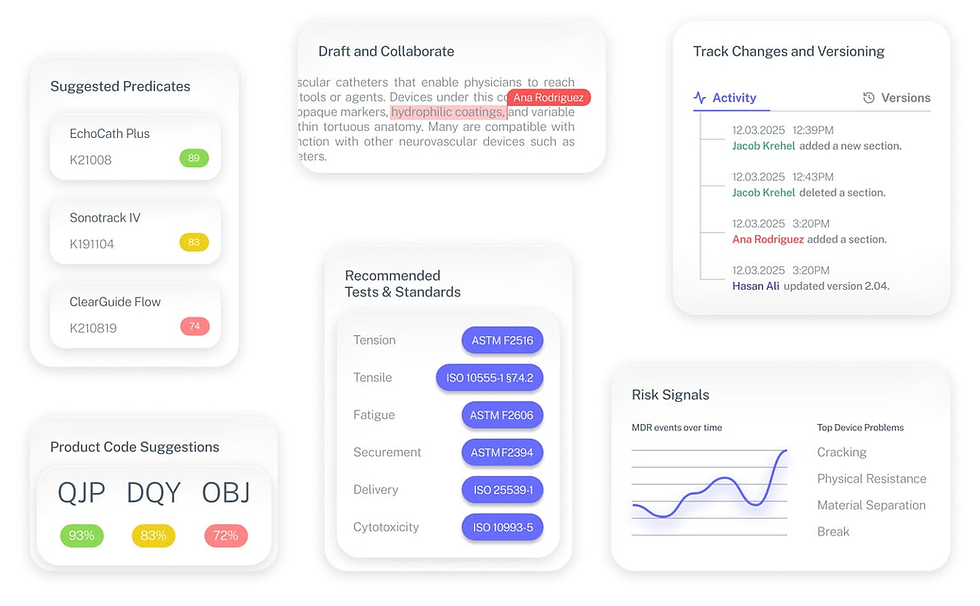
- FDA Product Code Finder, find your code in minutes.
- 510(k) Predicate Intelligence, see likely predicates with 510(k) links.
- Risk and Recalls, scan MAUDE and recall patterns.
- FDA Tests and Standards, map required tests from your code.
- Regulatory Strategy Workspace, pull it into a defendable plan.
👉 Get a free gap assessment, or try our free pathway finder and fee calculator.
Frequently asked questions
What does FDA's CDRH do?
The Center for Devices and Radiological Health (CDRH) regulates medical devices and radiation-emitting products sold in the United States. It classifies devices, reviews 510(k), De Novo and PMA submissions, inspects manufacturers and monitors safety after launch. Its Office of Product Evaluation and Quality handles premarket reviews through eight Offices of Health Technology.
What is the difference between 510(k) clearance and PMA approval?
A 510(k) shows your device is substantially equivalent to a legally marketed predicate, so FDA "clears" it. A PMA shows reasonable assurance of safety and effectiveness on its own evidence, usually including clinical data, so FDA "approves" it. PMA applies to high-risk Class III devices and costs far more in fees, time and evidence.
How long does FDA take to review a 510(k)?
FDA's goal is a decision within 90 FDA days. FDA days exclude time your submission spends on hold, such as while you answer an additional information request, so calendar time is longer. A complete eSTAR submission, a strong predicate and full testing are the best ways to avoid holds and keep your timeline short.
How much is the FDA 510(k) user fee?
From October 1, 2026, the standard 510(k) user fee is $28,653, and qualifying small businesses pay $7,163. For FY 2026 the fees were $26,067 and $6,517. FDA charges no user fee for a 510(k) reviewed by an accredited third party, though the third party charges its own fee.
When should I use the De Novo pathway?
Use De Novo when your device is novel, carries low to moderate risk and has no legally marketed predicate. A granted De Novo creates a new classification regulation, and your device becomes a predicate for future 510(k)s. From October 1, 2026, the standard fee is $191,020, or $47,755 for small businesses.
Do 510(k) devices need clinical data?
Most don't. Substantial equivalence is usually shown with bench, performance, biocompatibility and software testing. FDA may ask for clinical data when differences from your predicate raise questions that testing alone can't answer. PMA devices almost always need clinical data, and De Novo requests sometimes do, depending on the device's risks.
What is an FDA Pre-Submission?
A Pre-Submission (Pre-Sub) is a free request for FDA feedback before you file. You send specific questions about your testing, predicate or clinical plan, and FDA replies in writing, with an optional meeting. FDA aims to send feedback within 70 days. It is most useful for novel devices and unclear pathways.
What is a Submission Issue Request (SIR)?
A Submission Issue Request is a Q-Submission asking FDA for feedback on your plan to resolve issues raised in an FDA letter, such as an additional information request. It helps you confirm that your response will satisfy the reviewer before you invest in new testing or resubmit, which can save a full review cycle.
Do foreign manufacturers need a US Agent?
Yes. Every foreign establishment that registers with FDA must designate a US Agent who lives in, or has a place of business in, the United States. The US Agent is FDA's point of contact for communications and emergencies. You name them during establishment registration, which is required before commercial distribution.
When do I need to register my establishment with FDA?
Establishment registration and device listing are required before you begin commercial distribution of a device in the US, not before you receive 510(k) clearance. Registration is renewed each year between October 1 and December 31. The annual registration fee is $13,785 from October 1, 2026.
What is the QMSR and when did it take effect?
The Quality Management System Regulation (QMSR) replaced FDA's Quality System Regulation on February 2, 2026. It amends 21 CFR Part 820 to incorporate ISO 13485:2016 by reference, with some FDA-specific additions. It applies to manufacturers of finished devices sold in the US, including foreign manufacturers.
Can a CE mark replace FDA clearance?
No. The US does not accept CE marking or other foreign approvals in place of FDA clearance or approval. You still need a 510(k), De Novo or PMA unless your device is exempt. Some evidence, such as bench and biocompatibility testing, may be reusable if it meets FDA's expectations.
References
- 21 CFR Part 807, Subpart E: Premarket Notification
- 21 CFR Part 807: Establishment Registration and Device Listing
- 21 CFR Part 860, Subpart D: De Novo Classification
- 21 CFR Part 814: Premarket Approval of Medical Devices
- 21 CFR Part 820: Quality Management System Regulation
- FDA: Medical Device User Fee Amendments (MDUFA) Fees
- FDA: Medical Device User Fee Amendments 2022 (MDUFA V)
- FDA guidance: FDA and Industry Actions on 510(k) Submissions: Effect on FDA Review Clock and Goals
- FDA guidance: Requests for Feedback and Meetings for Medical Device Submissions: The Q-Submission Program
- FDA: Office of Product Evaluation and Quality
- FDA: Quality Management System Regulation Frequently Asked Questions
- FDA: Breakthrough Devices Program
- FDA draft guidance: Artificial Intelligence-Enabled Device Software Functions: Lifecycle Management and Marketing Submission Recommendations
- FDA: 510(k) Premarket Notification Database
- openFDA: Device 510(k) API. Annual clearance counts are 510(k) records with a substantially equivalent decision, by decision date, retrieved September 22, 2026.